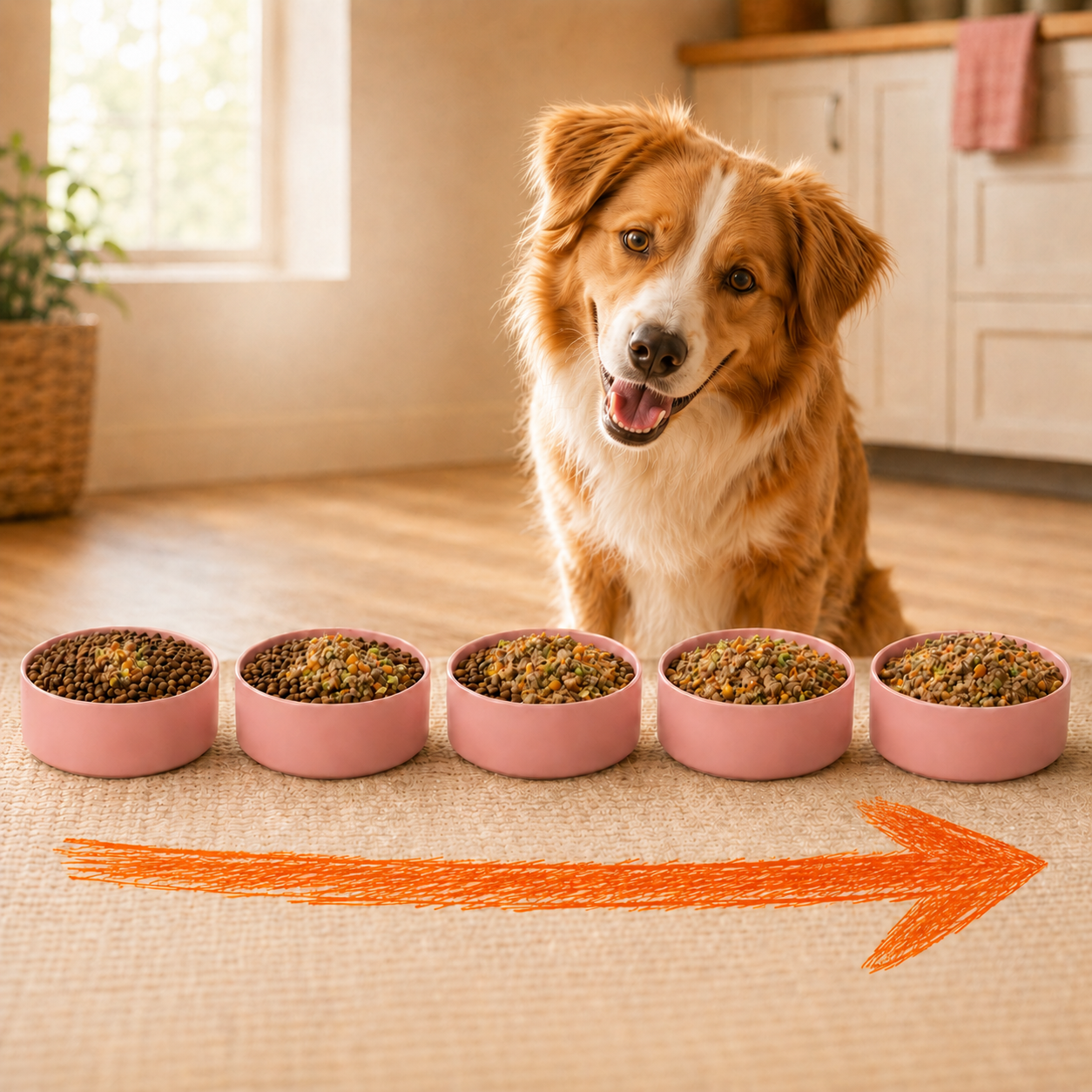




The hidden problem with feeding your senior dog the same food as a puppy
It’s the small things you notice first.
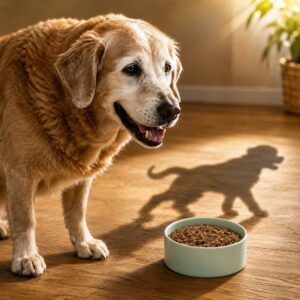
A pause at the bottom of the stairs that wasn’t there a year ago. A slower start in the morning. A bit of weight gained without anything in the routine actually changing. Stiffer back legs. Cloudy eyes. The occasional restless night. A quieter dinnertime, where the spinning and tail-wagging has been replaced by something more patient.
You’re not imagining it. Your dog is aging. And the food in their bowl, the same food that has worked for years, the food you bought because the packet said complete and balanced for all life stages, may not be working for them anymore.
If any of that sounds familiar, this article is for you.
First, Is Your Dog Actually a Senior?
A lot of pet parents are surprised to learn their dog crossed into senior territory a few years ago. Bigger dogs age faster than smaller ones:
• Small breeds (under 10 kg) become senior from around 10 to 12 years.
• Medium breeds (10 to 25 kg) become senior from around 8 to 10 years.
• Large breeds (25 to 40 kg) become senior from around 7 to 8 years.
• Giant breeds (over 40 kg) become senior from around 5 to 6 years.
A Great Dane is a senior at 6. A Yorkie is still middle-aged at 9. A generic, mass-produced recipe doesn’t know which dog is yours.
Common signs include cloudy eyes, greying around the muzzle, stiffness after long naps, less interest in long walks, more sleeping, subtle weight changes, and small shifts in behaviour like restless nights or moments of confusion.
None of these are emergencies. All of them are signals. They tell you the body in front of you isn’t the same body you fed two years ago.
What “All Life Stages” Really Means
Most of us assume “all life stages” means a food was carefully designed to work for every dog at every age. That’s the idea the words sell. The reality is much simpler, and a little uncomfortable.
There’s one main rulebook in pet food. It’s written by the Association of American Feed Control Officials (AAFCO), and it sets the nutrient standards that most commercial dog foods follow.
Here’s the part that surprises people. AAFCO has only ever recognised two nutrient profiles for dogs. Both were first published in 1991. The most recent update was in 2016. In more than 30 years, that has not changed.
1. Growth and Reproduction, for puppies and for mothers who are pregnant or nursing.
2. Adult Maintenance, for healthy adult dogs.
That’s the whole list. There is no AAFCO profile for senior dogs. None.
So how does a single recipe get to say it’s good for “all life stages”? It does it by meeting the higher of the two profiles, which is the puppy one. Puppies need more of nearly everything to grow. So if a food has enough nutrition for a puppy, the logic goes, it has enough for any dog.
Put plainly: “all life stages” is a puppy formula being sold to every dog in the house.
It’s also worth saying what AAFCO is, and what it isn’t. AAFCO doesn’t regulate or test pet food. It writes model guidelines that US states adopt. The “complete and balanced” claim on a packet is checked against minimums for survival, not optimums for thriving.
So when you read “all life stages” on a label, what you’re really reading is: this food clears a 1991 puppy minimum. Nothing more.
What Aging Really Does to a Dog’s Body
To understand why this matters, you have to understand what’s quietly changing inside an older dog. It’s more than slower walks and a greyer face.
Their engine runs slower. By the time a dog turns 7, their metabolism may have already slowed by as much as 25%. Senior dogs typically need 18 to 24% fewer calories than they did at their peak. The same scoop of food that kept them lean at 4 can quietly turn into extra weight at 9.
They lose muscle, fast. Between ages 7 and 12, senior dogs can lose 15 to 25% of their muscle mass, and their bodies become less efficient at turning protein into muscle. Current research suggests senior dogs may need up to 50% more protein than younger adult dogs, measured against metabolic body weight, to maintain lean mass. Higher-protein diets in healthy seniors are associated with stable kidney function and lower mortality, not the opposite.
For years, pet parents were told to reduce protein for older dogs to “protect the kidneys”. Current evidence does not support that advice for healthy seniors. The relevant variables for kidney health are phosphorus load and protein quality, not protein quantity.
Their kidneys become more sensitive. Filtration capacity declines gradually with age. Phosphorus, in particular, becomes harder for an aging kidney to manage, and excess phosphorus has been linked to accelerated kidney decline. In dogs with chronic kidney disease, phosphorus restriction can roughly double survival time.
Their joints wear. By some estimates, around 80% of dogs over 8 show signs of osteoarthritis on imaging, even when they look fine clinically. Glucosamine, chondroitin and omega-3 fatty acids have evidence supporting their role in cartilage maintenance and inflammation.
Their brain changes. Older dogs can develop Canine Cognitive Dysfunction, the canine equivalent of dementia. A landmark trial of a diet enriched with B vitamins, EPA/DHA, antioxidants and arginine found that 88% of treated dogs improved or did not progress over the study period.
Their gut and immune systems become more fragile. Senior digestion is slower and less efficient. Immune response weakens, and quiet, low-grade systemic inflammation rises with age.
A senior dog isn’t a smaller, older puppy. They’re a different animal entirely. Their food should treat them that way.
How much phosphorus is too much?
Worth pausing on the numbers, because this is where the gap between puppy minimums and senior needs becomes hardest to ignore.
AAFCO permits a wide window for phosphorus on a dry matter basis:
• Adult Maintenance: minimum 0.4%, maximum 1.6%.
• Growth & Reproduction (puppy or “all life stages”): minimum 1.0%, maximum 1.6%.
The puppy minimum is 2.5 times the adult minimum, by design. An “all life stages” formulation legally has to deliver puppy-level phosphorus to every dog who eats it. Many land in the 1.0 to 1.4% range.
For a healthy senior, most veterinary nutritionists target phosphorus around 0.5 to 0.8% on a dry matter basis, with a calcium-to-phosphorus ratio close to 1.2:1. Therapeutic renal diets for chronic kidney disease drop phosphorus further still.
The takeaway is simple. A senior eating an “all life stages” food at 1.2 to 1.4% phosphorus, perfectly legal under AAFCO rules, may be consuming nearly double the phosphorus their kidneys would prefer, every day, for years.
What Happens When a Senior Eats a Puppy Formula
When a senior dog eats a food built for a growing puppy, three things tend to happen. None of them are dramatic on day one. All of them compound over time.
1. Slow weight gain
Puppy-grade calories meet senior-grade activity, and the scale drifts. The food doesn’t know your dog has slowed down.
A landmark 14-year Purina study followed Labrador littermates over their entire lives. The dogs kept at a lean body weight lived a median 1.8 years longer than littermates who were just 25% heavier.
Almost two extra years of life, from staying lean alone.
Even a 10% excess in body weight is associated with higher rates of arthritis, diabetes, and cardiac, hepatic and renal disease. The risk is sharper still for urban senior dogs: apartment-living, neutered, mostly-on-leash. Neutering lowers calorie needs by 20 to 30%. City living lowers exercise. Puppy-grade food on top of that makes the maths impossible.
2. Quiet nutrient overload
“All life stages” diets are routinely higher in calcium, phosphorus, zinc, copper and sodium than an adult or senior dog needs. That’s not a flaw in the design. Puppies need those extras to build bone and tissue. Your senior isn’t building anything new. They’re maintaining what they have, and the excess load on aging kidneys, joints and the cardiovascular system accumulates silently.
By the time the consequences appear in bloodwork, the damage is already underway.
3. Functional ingredients missing entirely
AAFCO “all life stages” approval does not require any of the things that actually help a senior dog age well: glucosamine or chondroitin for joints, EPA and DHA omega-3s at therapeutic levels, B vitamins and antioxidants for cognitive support, probiotics and prebiotic fibres for an aging gut, or anti-inflammatory functional ingredients like turmeric and mushroom extracts.
A standard “all life stages” food can meet every AAFCO requirement, sit on a shelf with “complete and balanced” on the label, and still leave out everything that could ease an older dog’s stiff mornings, sharpen their foggy afternoons, and protect their kidneys for years to come.
Your dog is, in effect, being asked to eat for a body they no longer have.
The Mistakes Pet Parents Make Next
Once people realise their senior is eating the wrong food, the response often falls into one of four well-meaning but unhelpful patterns.
“They should eat less.” Cutting portions without changing the formulation is the opposite of what a senior needs. A senior on too little food loses muscle faster, weakens immunity, and ends up more frail. The answer is not less food. It’s a smarter formulation: denser in nutrients, less in fillers, calibrated to the dog’s actual energy needs.
“They need lower protein, to protect the kidneys.” Not true for healthy seniors. Reduced protein has been shown to accelerate muscle loss in older dogs. Protein restriction is a clinical intervention for diagnosed chronic kidney disease, and even there it’s primarily about phosphorus load and protein quality, not protein quantity.
“If it was good enough as a puppy, it’s good enough now.” The body in front of you is not the same body that started on this food. Asking a 12-year-old dog to thrive on a puppy formula is like asking a 70-year-old human to eat a teenage athlete’s diet.
“My dog still looks fine, so I don’t need to change anything.” Most senior decline is invisible until it isn’t. Muscle loss, kidney decline, joint wear and cognitive shift all happen quietly. By the time the signs are clinically obvious, the easy window to slow them with nutrition has already closed.
The Real Problem
The problem isn’t that “all life stages” foods are bad. Most are formulated exactly as intended.
The problem is that they were never designed for senior dogs in the first place.
A puppy and a senior may both be dogs. But one is building a body. The other is trying to preserve one.
That difference changes everything.
And once you understand that, the next question becomes obvious. What should a senior dog actually be eating?
What a Senior Diet Should Actually Look Like
Most dog foods start with a recipe.
Senior nutrition should start with the dog.
Not the average dog. This dog. The one sitting in front of you.
That means starting from their metabolic body weight, their stage of life, their actual calorie and nutrient needs. Not from a 1991 minimum or a single percentage on a packet.
Two simple ideas sit underneath that approach. Once you see them, you can’t unsee them. They quietly reshape how every dog food label reads.
Dogs need nutrients, not ingredients
Your dog doesn’t taste the ingredients on a label. Their body doesn’t recognise “real chicken” or “whole salmon” the way the marketing does. What their body actually absorbs and uses is nutrients: amino acids, fatty acids, vitamins, minerals.
A bowl of plain raw chicken every day is, technically, fresh. It’s also not a complete diet. Over time, it would make your dog sick. The ingredient is fine. The nutrition isn’t.
That’s why the case for fresh food isn’t simply that “fresh” is healthier in some general sense. It’s that the alternative comes with real costs. The high-heat processing used to make shelf-stable dry food damages nutrients on their way into the bowl, and the recipes have to compensate with starchy fillers and synthetic supplementation to make the numbers work on paper. Minimally processed food, properly formulated, doesn’t need that workaround.
Dogs eat grams, not percentages
A percentage on a packet is a ratio. It tells you a nutrient’s share of the recipe. It tells you nothing about how much of that nutrient your dog actually eats.
Two foods at the same percentage can deliver wildly different absolute amounts. A 25% fat kibble padded with starchy carbs is a very different food from a 25% fat ancestral fresh diet built almost entirely on protein and fat. Feed each one to meet the same daily calories, and your dog ends up consuming very different grams of fat. Same headline number. Very different reality in the bowl.
The National Research Council understands this, and it has shaped how the NRC writes its standards. The NRC doesn’t think in percentages. It writes nutrient targets in grams per kilogram of metabolic body weight per day, nutrient by nutrient. A healthy 10 kg senior, for example, needs in the region of 25 to 30 grams of high-quality protein per day. Twenty-five grams is twenty-five grams. The packet’s percentage doesn’t move that number an inch.
So every “high protein” or “low protein” claim should be read through one question, and only one: how many grams is my dog actually getting, against the metabolic weight of their body?
What a senior-appropriate diet actually delivers
With those two ideas in place, you can stop reading labels for their packaging and start reading them for what the food actually does. Four things matter.
1. Highly digestible protein, in the amounts a senior needs.
Senior dogs need more protein than adult dogs. That part is settled.
The complication is that the protein on a label and the protein your dog actually absorbs are not the same number. What changes them is what happens to that protein before it ever reaches the bowl.
Heat damages protein. The higher the temperature, and the longer the cooking, the worse the damage. A damaged protein is harder for your dog’s gut to break down. Less of it ends up actually feeding the dog.
This is the quiet problem with most dry food. Extrusion, the process that turns wet ingredients into shelf-stable kibble, runs at 100 to 200°C. At those temperatures, two things go wrong at once. The protein’s natural shape breaks down. And the heat sets off a chemical reaction called the Maillard reaction, which binds essential amino acids like lysine to sugars and locks them in a form the gut can no longer fully use. Feeding studies confirm what the chemistry predicts: amino acid availability is measurably lower in extruded food than in fresh or freeze-dried alternatives (van Rooijen et al., Nutrition Research Reviews; Oba et al., PMC; Tran et al., ScienceDirect).
Minimally processed protein, raw or gently cooked and then freeze-dried, keeps its natural shape intact. Your dog absorbs more of it, gram for gram. A senior diet should start there: undamaged protein, in enough quantity to meet the higher needs of an aging body.
2. Nutritional completeness, calculated for this dog.
A senior diet should be measured against the National Research Council’s standards. The NRC does two things, and they’re worth understanding separately. It tells you how many calories your dog needs, and it tells you how much of each nutrient your dog needs.
Calories are personal. They depend on weight, body condition, neuter status, and how much your dog actually moves. A neutered senior who naps most of the day has very different calorie needs from an active senior who still walks five kilometres before breakfast. The NRC starts from your dog’s metabolic body weight, then adjusts for those factors.
Nutrient targets work differently. Each essential nutrient gets its own number, set in grams (or milligrams) per kilogram of metabolic body weight per day. A healthy 10 kg senior has a daily target in absolute grams for protein, fat, calcium, phosphorus, omega-3 and every other essential nutrient. Not percentages. Amounts the dog actually has to absorb.
In practice, this means a correctly formulated senior diet isn’t one recipe applied to every senior. It’s a plan that meets your dog’s specific calorie need and each NRC nutrient target, every day. A generic feeding chart can’t promise that. An individual calculation against your dog’s metabolic body weight can.
3. The right amounts, without the overload.
Senior bodies are sensitive to excess in a way younger bodies are not.
Excess phosphorus speeds up kidney decline, even in dogs whose bloodwork still looks normal. Excess calcium throws off the calcium-to-phosphorus balance that aging skeletons depend on. Excess sodium is a real concern in seniors with quietly developing heart disease. And excess calories drive obesity, which independently shortens lifespan by a median of 1.8 years (the Purina study again).
So a senior diet has to meet every NRC nutrient target while staying out of overload territory. Phosphorus moderated to around 0.5 to 0.8% on a dry matter basis. A calcium-to-phosphorus ratio in the region of 1.2:1. Sodium controlled. Calories matched to what your dog actually burns, not a generic chart on the side of a packet.
This is where “complete and balanced” stops being a marketing slogan and starts being a real engineering target.
4. Functional ingredients for the conditions of aging.
Beyond the baseline nutrient profile, a good senior diet adds the things that target the specific changes of aging. Four areas matter most: joints, brain, immune system, and gut. Each one changes in a fairly predictable way as a dog gets older. And for each one, there’s a real, evidence-based nutritional response.
Joints and mobility.
It usually shows up in the small hesitations. The slow rise from the floor after a nap. The pause at the bottom of the stairs that wasn’t there last year. The look up at the couch they used to launch onto without thinking. Your dog isn’t refusing. They’re measuring.
By age 8, around 80% of dogs show signs of osteoarthritis on imaging, even when they look completely fine from the outside. Inside the joint, cartilage thins, joint fluid drops, and low-grade inflammation slowly builds.
The nutritional response is doing two jobs at once: building cartilage back up, and calming the inflammation around it. Glucosamine supplies the building blocks for new cartilage. Chondroitin sulfate slows the breakdown of existing cartilage and improves joint fluid quality. EPA and DHA omega-3 fatty acids dampen the inflammatory signalling that drives the stiffness you see in your dog every morning.
These can meaningfully slow the loss of mobility. But only at therapeutic doses. A single ingredient mention on a packet, with no quantity attached, is more decoration than medicine.
The aging brain.
Sometimes it starts with a doorway. Your dog walks into a room. Then pauses. Not because they are injured. Not because they are tired. Just because, for a moment, they seem unsure why they went there.
What you’re seeing has a name. Vets call it Canine Cognitive Dysfunction, the canine version of dementia. The signs are quiet at first. Getting “lost” in a familiar room. Restless nights. Less interest in greeting you at the door.
What’s going on inside is three things at once. The aging brain runs less efficiently on glucose, accumulates oxidative damage, and produces less of certain key brain chemicals. Nutrition has something to say on all three fronts. EPA and DHA omega-3s support brain cell membranes and dial down brain inflammation. B vitamins are required to make the neurotransmitters the brain runs on. Arginine supports healthy blood flow. MCT (medium-chain triglyceride) oil gives aging brain cells an alternative energy source they can still use efficiently when glucose metabolism starts faltering. Antioxidants like astaxanthin and Ginkgo biloba protect brain cells from oxidative damage.
A landmark clinical trial of a diet built around this combination reported that 88% of treated dogs either improved or stopped declining over the study period. That’s a remarkable result for any intervention, let alone one delivered in a bowl.
The immune system and “inflammaging”.
It’s the slower recovery you notice first. A small infection that lingers a few days longer than it used to. A patch of skin that takes weeks to settle. A coat that has lost some of its old shine. A sense, hard to put your finger on, that your dog is aging faster than the calendar would suggest.
What you’re seeing from the outside is what’s quietly going on inside. With age, two things happen to the immune system at the same time. It becomes less responsive when it needs to react. And it produces a chronic, low-grade inflammation across the rest of the body.
Researchers gave this a name: “inflammaging”. It contributes to joint pain, cognitive decline, gut sensitivity, and that vague sense your dog has aged a year in the last six months. The nutritional response targets both sides. Turmeric (the active compound is curcumin) modulates inflammatory pathways. Ashwagandha supports immune balance and helps the body cope with chronic stress. Blueberry extract delivers a concentrated dose of polyphenol antioxidants. Astaxanthin is one of the most potent antioxidants currently identified, with particularly strong activity against oxidative damage in aging tissue. Turkey tail mushroom provides beta-glucans that support immune function. Moringa rounds out the picture with additional antioxidants and a broad spread of micronutrients.
The aging gut.
It’s the small changes in the routine. A meal that doesn’t quite agree. A walk that needs to happen a little sooner than it used to. A stool that isn’t quite what it was. Your dog’s gut is doing the same job it always did. It’s just doing it less well.
Inside, three things are slowing down at once. Motility drops. Nutrient absorption gets less efficient. The microbiome loses diversity and resilience.
This matters far beyond digestion, because around 70% of the immune system actually lives in the gut wall. A struggling senior gut means a struggling senior immune system. Get the gut right, and a lot of other things start falling into place.
Functional gut support starts with prebiotic fibres that feed beneficial gut bacteria without overwhelming a sensitive system. Psyllium husk and acacia gum are soluble fibres especially well tolerated by senior digestion, gentler than the beet pulp and chicory root most commercial diets reach for. Buckwheat and whole vegetables add further fermentable fibre, with their own micronutrients on top. Probiotics directly restore microbial diversity.
The combined effect is more regular digestion, better absorption from the food your dog is already eating, and a stronger gut barrier. Which in turn supports the immune system, dampens inflammation, and quietly improves everything else we just walked through.
These four layers aren’t optional add-ons to a baseline maintenance diet. They are the difference between a diet that lets your dog survive their senior years, and one that actually supports them through them.
A formulation that delivers on all four meets the real nutritional requirements of an aging dog. A formulation that satisfies only AAFCO “all life stages” minimums almost certainly does not.
Where to Go From Here
If there’s one thing to take away from this article, it’s this.
A puppy and a senior may both be dogs. But one is building a body. The other is trying to preserve one.
That simple difference changes everything.
So before you buy the next bag, box, or subscription, ask yourself three questions:
• Was this food actually designed for senior dogs?
• Is it providing the nutrients my dog needs today, in the amounts they actually need them?
• Is it helping my dog age well, or simply helping them get older?
Because the goal is not simply a longer life. It is more good years.
Your dog has spent a lifetime giving you their best years. Their food should help them make the most of the years that remain.
Sources:
- AAFCO Approved Dog Food & Nutrient Profiles, Purina — https://www.purina.com/articles/dog/health/nutrition/aafco-dog-food
- AAFCO Dog Food Nutrient Profiles FAQ, Dog Food Advisor — https://www.dogfoodadvisor.com/frequently-asked-questions/aafco-nutrient-profiles/
- “Complete and Balanced” Pet Food, FDA — https://www.fda.gov/animal-veterinary/animal-health-literacy/complete-and-balanced-pet-food
- Life-Stage Feeding, Dog Food Advisor — https://www.dogfoodadvisor.com/canine-nutrition/life-stage-feeding-dogs/
- Feeding Mature and Senior Dogs, VCA Animal Hospitals — https://vcahospitals.com/know-your-pet/feeding-mature-and-senior-dogs
- The Right Amount of Protein for Senior Dogs, Petaluma — https://www.feedpetaluma.com/blogs/blog/the-right-amount-of-protein-for-senior-dogs-a-science-based-guide-to-healthy-aging
- The Power of Protein, WPS GSS — https://www.wpsgss.org/post/protein-for-senior-dogs-benefits-of-protein-in-aging-pets
- Nutritional Needs of Senior Dogs, IAMS — https://www.iams.com/dog/dog-articles/nutrition-and-your-senior-dogs-body
- Is Senior Dog Food Lower in Calories?, Houndsy — https://www.houndsy.com/blogs/modern-tails/is-senior-dog-food-lower-in-calories
- Senior Dog Nutrition 2026 Guide, Pet Calorie Calculator — https://petcalorie.com/blog/senior-dog-nutrition-complete-guide-feeding-aging-dog
- Therapeutic Diet on Dogs with CDS, Frontiers in Nutrition — https://www.frontiersin.org/journals/nutrition/articles/10.3389/fnut.2018.00127/full
- Cognitive functions in aged dogs and cats, PMC — https://pmc.ncbi.nlm.nih.gov/articles/PMC12181554/
- High Phosphorus in Dogs, VetLens — https://www.vetlens.com/blog/high-phosphorus-in-dogs
- Serum calcium and phosphorus concentrations in dogs with CKD, JAVMA — https://avmajournals.avma.org/view/journals/javma/245/10/javma.245.10.1135.xml
- Plasma calcium-phosphorus product and lifespan in CKD dogs, PMC — https://pmc.ncbi.nlm.nih.gov/articles/PMC6855231/
- Obesity in Dogs, AKC — https://www.akc.org/expert-advice/nutrition/obesity-in-dogs-a-major-health-threat-hiding-in-plain-sight/
- Nutrient composition of adult and senior dog diets, Frontiers in Veterinary Science — https://www.frontiersin.org/journals/veterinary-science/articles/10.3389/fvets.2025.1717409/full
- Nutrition requirements of senior pets, Veterinary Practice — https://www.veterinary-practice.com/article/nutrition-requirements-of-senior-pets
- Senior dog diet, Wikipedia — https://en.wikipedia.org/wiki/Senior_dog_diet
- Understanding Diet Transition in Dogs, YoDoggo — https://yodoggo.com/understanding-diet-transition-in-dogs/
- AAFCO Dog and Cat Food Nutrient Profiles (phosphorus min/max), AAFCO — https://www.aafco.org/wp-content/uploads/2023/01/Model_Bills_and_Regulations_Agenda_Midyear_2015_Final_Attachment_A.__Proposed_revisions_to_AAFCO_Nutrient_Profiles_PFC_Final_070214.pdf
- Dietary Guidelines for Dogs with CKD, Today’s Veterinary Practice — https://todaysveterinarypractice.com/nutrition/diet-dogs-ckd-chronic-kidney-disease/
- Best Low-Phosphorus Dog Food Guide, SmartPupFood — https://smartpupfood.com/low-phosphorus-dog-food/
- Calcium and phosphorus, getting the balance right, Royal Canin Academy — https://academy.royalcanin.com/en/veterinary/calcium-and-phosphorus-getting-the-balance-right
Social Share