




Gut, Digestive, and Metabolic Adaptation
Switching your dog to a higher-protein, higher-fat diet isn’t just a food change—it’s a biological shift. Digestion, gut bacteria, and energy systems all need time to adapt. This is why transitions can feel inconsistent or seem to go wrong. This guide explains what’s actually happening inside your dog’s body, why most transitions fail, and how to manage the process properly for long-term health and stability.
1. Summary
Most modern dog diets are high in carbohydrates, especially from starch. Dogs can digest carbohydrates, but they do not need them as an essential nutrient.
Moving to a diet that is higher in protein and fat, and lower in carbohydrates, is not just a change in ingredients. It is a change in how the body works. It affects digestion, the gut microbiome, and how the body produces and uses energy.
Two main systems are involved in this transition:
- The gut microbiome (adapts quickly)
When protein increases, the types of bacteria in the gut change. In the early stages, protein digestion may not be fully efficient, which can lead to more protein reaching the large intestine. This can cause softer stools and temporary digestive changes.
- Digestion and metabolism (adapt more slowly)
Fat digestion takes longer to adjust. The body needs time to increase bile production, enzyme activity, and its ability to use fat as a main energy source. This process can take several weeks.
Most issues during transition are not because the food is wrong. They happen because the body has not yet fully adapted to the new diet.
Short transition plans of 7 to 14 days are usually designed for switching between similar foods, where the levels of protein, fat, and carbohydrates do not change much. When the diet changes more significantly, especially with higher fat and lower carbohydrates, the body needs more time.
A 30-day transition is a good starting point, but it should not be followed rigidly. The pace should depend on how the dog responds, especially stool quality.
In many cases, full adaptation can take 4 to 12 weeks, depending on how large the dietary change is.
Understanding what is happening in the body helps pet parents manage the process better, adjust when needed, and support a smoother transition.
2. Introduction: Why This Shift Matters
Modern feeding practices have made carbohydrate-rich diets the norm for dogs. Many commercial foods, especially dry kibble, get a large portion of their calories from starch. Even in other formats, similar patterns appear through the use of grains, legumes, or starchy vegetables.
Dogs can digest carbohydrates well. Research shows that dogs have more copies of the gene for amylase than their wolf ancestors. Amylase is an enzyme that helps break down starch (Axelsson et al., 2013).
But the ability to digest something is not the same as needing it. According to the National Research Council, carbohydrates are not an essential nutrient for dogs. Dogs can maintain normal blood sugar levels by producing glucose internally. They use amino acids from protein and glycerol from fat to do this.
Protein and fat provide the key nutrients dogs need. Protein supplies essential amino acids for muscle, tissue repair, enzymes, and immune function. Fat provides a dense source of energy and essential fatty acids that support cell structure and many metabolic processes.
Carbohydrate-rich meals also affect how the body handles energy. In dogs, these meals can raise blood glucose levels, which then triggers a rise in insulin. Insulin is essential. However, frequent spikes can cause more fat storage, reduced fat burning, and low-grade inflammation.
Diets that are higher in protein and fat, but lower in carbohydrates, usually lead to smaller changes in blood glucose and insulin. This supports a more stable energy system and allows the body to rely more on fat as a fuel source.
Because of this, moving from a carbohydrate-heavy diet to a higher-protein, balanced-fat diet is not just a change in ingredients. It is a shift in how the body produces and uses energy.
This shift takes time. Several systems in the body need to adapt. This includes the gut microbiome, digestive enzymes, bile acids, and cellular energy pathways. Each of these systems adapts at a different pace.
Understanding this is important. Many problems seen during diet transition are not caused by the food itself, but by the body still adjusting to a new way of processing nutrients.
This paper explains how the transition works. It focuses on changes in the gut, digestion, and metabolism. It also covers what these changes mean for managing diet in dogs.
3. The Two Core Adaptations During Diet Transition
When a dog moves from a carbohydrate-rich diet to a higher-protein, higher-fat diet, two fundamental changes take place in the body.
The gut microbiome begins to shift.
Digestion and metabolism begin to adapt.
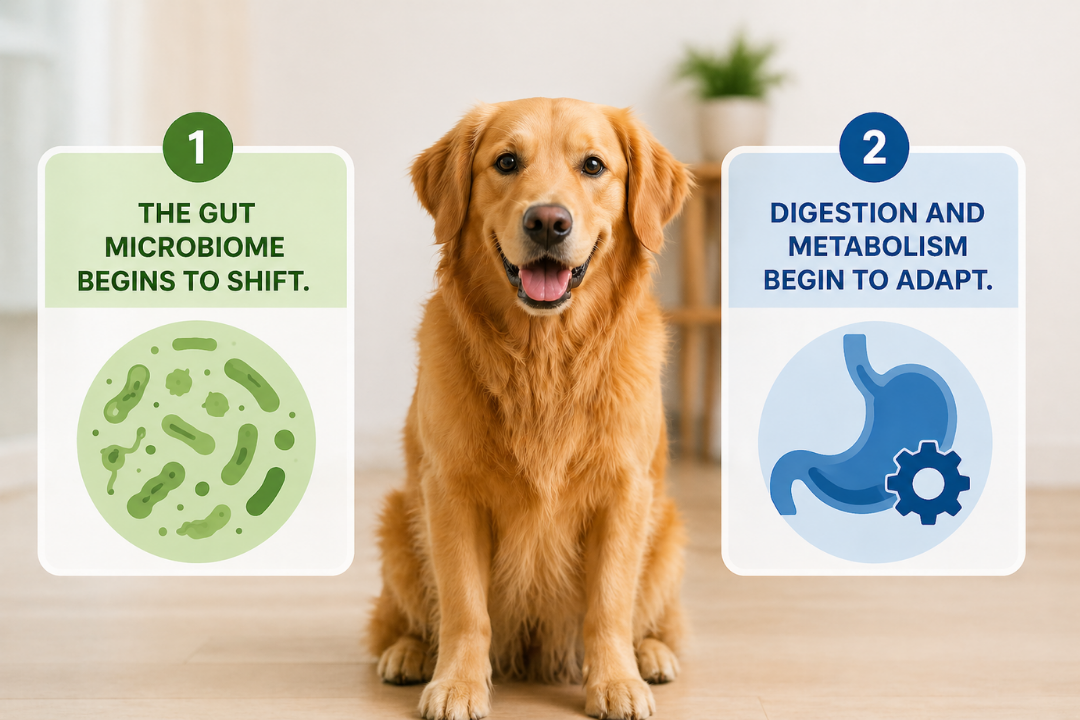
These systems respond at different speeds, and most digestive changes during transition can be explained by this mismatch.
3.1 Higher Protein and the Gut Microbiome
An increase in dietary protein directly affects the gut microbiome.
The types of bacteria in the gut depend on what reaches the large intestine. Under normal conditions, most protein is broken down and absorbed in the small intestine, and only a small amount reaches the colon. However, during the early stages of a diet transition, protein digestion may not yet be fully efficient. This means that a larger amount of undigested protein can pass into the large intestine.
When this happens, the microbiome begins to shift. Bacteria that can break down protein start to increase, including some groups within the Clostridia class. Research in dogs shows that increasing dietary protein alters gut microbiota and increases protein-fermenting bacteria (Sandri et al., 2017; Bermingham et al., 2017).
These bacteria break down protein and produce a different set of byproducts compared to fibre fermentation. These include compounds such as ammonia, biogenic amines, and other metabolites, which can affect the gut environment and stool quality.
Some of these compounds can irritate the intestinal lining or alter water balance in the gut. The body may respond by increasing water in the stool or by moving contents through the digestive tract more quickly. This is why dogs may experience loose stools, softer stool consistency, or changes in stool odor during the early phase of transition.
At this stage, the issue is not the protein itself. The issue is that the digestive system has not yet fully adapted, so more protein than usual is reaching the large intestine.
As the body adjusts, protein digestion improves. The small intestine becomes more efficient at breaking down and absorbing protein, which means less undigested protein reaches the colon. As this happens, protein fermentation in the large intestine reduces.
At the same time, the microbiome begins to stabilize. In the large intestine, bacteria do not primarily rely on digestible carbohydrates like starch. Instead, they rely more on fibre that escapes digestion in the upper gut. This fibre is fermented by specific bacterial groups that produce short-chain fatty acids (SCFAs), including acetate, propionate, and butyrate (Flint et al., 2012).
These SCFAs support the intestinal lining, help regulate water balance, and contribute to overall gut stability (Koh et al., 2016).
As this balance is restored, stool quality improves and digestion becomes more stable.
This process usually occurs relatively quickly, often within one to two weeks. The temporary rise in protein-fermenting bacteria is a short-term response to increased protein intake and incomplete digestion during the early phase of transition.
3.2 Higher Fat and Fat Digestion
An increase in dietary fat affects digestion in a different way.
Fat digestion is more complex than carbohydrate or protein digestion. It depends on coordinated actions between bile acids, digestive enzymes, and intestinal absorption.
When a dog consumes fat, it must first be emulsified by bile acids. Bile is produced in the liver, stored in the gallbladder, and released into the small intestine in response to fat intake. This breaks large fat droplets into smaller ones, increasing the surface area for enzymes to act on.
Once emulsified, fat is broken down by pancreatic lipase into fatty acids and monoglycerides, which are then absorbed through the intestinal lining.
When dietary fat increases, all parts of this system need to adjust. The body must increase bile production and release, enhance lipase activity, and improve the efficiency of fat absorption.
This adaptation does not happen immediately.
In the early stages of transition, bile secretion may not yet match the higher fat intake, and enzyme activity may not be fully upregulated. As a result, some fat may remain undigested in the intestine.
Undigested fat can disrupt normal digestion. It reduces water absorption and increases intestinal motility, which can lead to softer or loose stools.
At the same time, bile acid handling plays an important role. Under normal conditions, most bile acids are reabsorbed in the lower small intestine and recycled. During transition, this system may not yet be fully efficient, allowing excess bile acids to pass into the large intestine.
Bile acids in the colon can stimulate water secretion and increase gut movement, further contributing to loose or poorly formed stools.
Over time, the body adapts. Bile production becomes better matched to the diet, enzyme activity increases, and fat absorption improves. Bile acid recycling also becomes more efficient.
Studies show that adaptation to higher fat intake involves changes in bile acid metabolism and digestive enzyme activity, and this process occurs over a longer period, often several weeks.
As these systems adapt, less fat remains undigested, bile acids are more effectively reabsorbed, and stool quality stabilises.
3.3 Why This Matters
Understanding these two processes changes how diet transition is interpreted.
Digestive changes during transition are often assumed to mean that the food does not suit the dog. In many cases, this is not correct.
During this phase, the body is still adjusting to a new nutrient profile. Protein digestion may not yet be fully efficient, and the gut microbiome is still adapting. At the same time, fat digestion and bile acid handling are not yet fully optimised.
This means digestive symptoms can appear even when the food itself is appropriate.
These effects are usually temporary and resolve as digestion improves, the microbiome stabilises, and fat digestion becomes more efficient.
Because of this, early digestive changes should not be immediately interpreted
4. The Long-Term Metabolic Shift
Moving from a carbohydrate-rich diet to a higher-protein, higher-fat diet does not only affect digestion. Over time, it changes how the body produces and uses energy.
This shift involves changes in glucose regulation, fat metabolism, and cellular energy pathways.
4.1 Energy Requirements and Substrate Use
The body has different types of energy needs, and not all of them are met in the same way.
Some functions require glucose specifically. Certain cells depend on glucose as their primary fuel, including red blood cells, parts of the brain, and sections of the kidney. These tissues either cannot use fat directly or have a limited ability to do so. Because of this, the body must always maintain a stable supply of glucose.
At the same time, most of the body’s energy requirements are met through the production of ATP (adenosine triphosphate), the usable form of energy inside cells. ATP powers processes such as muscle contraction, cellular repair, and normal metabolic activity.
ATP can be produced from multiple substrates, including glucose, fatty acids, and amino acids.
In a carbohydrate-rich diet, a large portion of ATP is produced from glucose. After a meal, glucose enters the bloodstream, insulin is released, and cells use this glucose for energy or store it.
In a higher-protein, higher-fat diet, this pattern changes. Glucose is still required for specific functions, but it is no longer dependent on dietary carbohydrates. Instead, the body produces glucose internally through gluconeogenesis, using amino acids from protein and glycerol from fat (NRC, 2006).
At the same time, fatty acids become the main source of energy for most tissues. They are broken down in the mitochondria through β-oxidation, producing ATP in a sustained manner.
Over time, this creates a more organised system of energy use:
- glucose is produced as needed for specific tissues
- fatty acids provide most of the ATP for overall energy demands
- protein supports structure and function, with a secondary role in glucose production
4.2 Regulation of Blood Glucose and Insulin
In carbohydrate-rich diets, increases in blood glucose after a meal lead to increases in insulin. Insulin allows cells to take up glucose for immediate use or storage, and at the same time suppresses the breakdown of fat (Ludwig, 2002).
This creates a system where fuel use is largely driven by dietary intake. After a meal, glucose becomes the primary energy source, while fat utilisation is reduced.
With frequent carbohydrate intake, this cycle repeats throughout the day, with insulin repeatedly rising and falling in response to blood glucose levels.
In diets lower in carbohydrates, post-meal increases in blood glucose are smaller. As a result, insulin responses are also lower and more stable.
Lower insulin levels reduce the suppression of fat breakdown. This allows fatty acids to be released and used more consistently as an energy source, rather than being intermittently switched off (Goodpaster & Sparks, 2017).
Over time, this leads to a shift in fuel use. Instead of alternating between glucose and fat depending on recent food intake, the body is able to use both more continuously.
4.3 Adaptation of Fat Metabolism
Adaptation to a higher-fat diet does not happen immediately. Compared to changes in the gut microbiome, which can occur within days, the body’s ability to efficiently digest and utilise fat develops more slowly.
Studies in dogs have shown that adaptation to higher fat intake can take several weeks. More recent work also supports that changes in fat metabolism and energy utilisation occur over a longer period with sustained dietary exposure.
This slower adaptation is due to the number of systems involved.
Fat metabolism requires coordinated changes across digestion, absorption, transport, and cellular energy production. Each of these processes depends on physiological adjustments that take time to develop.
At the digestive level, bile production and enzyme activity must adjust to match the higher fat intake. These changes depend on repeated stimulation from the diet and do not increase instantly.
At the cellular level, tissues need to increase their capacity to use fatty acids for energy. This involves changes in enzyme activity and mitochondrial function, which occur gradually with continued exposure to dietary fat.
Hormonal regulation also plays a role. Lower and more stable insulin levels support greater use of fatty acids as an energy source, but this shift develops over time rather than immediately.
Because these adaptations occur across multiple systems, the overall process is gradual.
During this period, fat digestion and utilisation may not yet be fully efficient. This is why digestive signs such as softer stools or changes in stool consistency can persist longer compared to microbiome-related changes.
In some dogs, this process may not be linear. Periods of improvement can be followed by temporary setbacks, as different systems adjust at different rates. This can present as a “yo-yo” pattern in stool quality during the transition phase.
Over time, as these systems stabilise, fat digestion becomes more efficient, fatty acid utilisation improves, and energy production from fat becomes more consistent.
4.4 Long-Term Metabolic Outcome
As these adaptations occur, the body moves toward a more stable and efficient metabolic state.
Energy production becomes less dependent on rapid increases in blood glucose and more dependent on a continuous supply of fuel. Instead of relying heavily on glucose from recent meals, the body draws more consistently on fatty acids for energy, while maintaining glucose internally for essential functions.
This creates a system where energy availability is less influenced by the timing and composition of individual meals.
At the same time, energy regulation becomes more controlled. Lower and more stable insulin levels allow both glucose and fat to be used in a more balanced way, rather than switching sharply between the two.
As a result:
- energy supply becomes more consistent over time
- reliance on frequent carbohydrate intake is reduced
- fat is used more efficiently as a primary fuel source
This also supports better alignment between energy intake and energy use. Nutrients are less likely to be rapidly stored and more likely to be utilised as part of normal metabolic activity.
Over time, these changes lead to a system that is more predictable, less reactive to short-term dietary fluctuations, and better adapted to using multiple energy sources efficiently.
5 Every Dog is Different
What to Watch and How to Adjust
No two dogs adapt at the same rate.
The 30-day transition provides a structure, but it is not something that should be followed rigidly. The pace of the transition should be guided by how your dog responds at each stage.
The most reliable signal during this process is stool quality. It reflects how well the digestive system is handling the increase in protein and fat intake.
My dog’s stools are soft during the transition phase. What should I do?
It is normal to see some variation during the transition. However, the moment stools become noticeably softer than normal, it is a signal that the digestive system is under stress.
At this point, you should not continue progressing the transition.
Instead, the focus should shift to stabilising the gut.
The first step is to fast the dog for 24 hours (no food and no treats). However, ensure there is access to fresh water at all times to maintain good levels of hydration. The goal is to give the digestive system a complete break and allow the intestinal lining time to recover.
After this period, feeding should resume at the last stage where stools were firm and well-formed. This is the level the body has already adapted to.
Stay at this level until stools are stable again.
Once stability returns, the transition can continue, but at a slower pace. This usually means spending more time at each stage and allowing the body to fully adjust before increasing the proportion of the new food.
There is no need to restart the transition from the beginning. By this stage, the body has already adapted to earlier levels. Restarting only delays overall progress.
The transition should be adjusted by controlling the rate of progression, not by reversing it.
Example
If you are on Day 12, feeding around 60% new food and 40% old food, and stools become soft, you stop feeding for 24 hours.
After the fast, you return to the previous stable level, for example 40% new food and 60% old food. You stay there until stools are firm again, and then continue the transition more gradually.
My dog is taking more than 30 days to transition. Is that a problem?
No.
The 30-day plan is only a guideline. The actual duration depends on how large the dietary change is and how quickly your dog adapts.
A slower transition is normal and often more effective.
My dog seemed fully transitioned, but stools are soft again. What does this mean?
This usually happens during the later stages of adaptation, especially as fat digestion continues to adjust.
The same approach applies:
pause feeding, return to the last stable level, allow recovery, and then continue more gradually.
6. Rethinking the 7–14 Day Transition
Many pet parents come across transition guidelines that recommend switching foods over 7 to 14 days.
While these guidelines are widely used, it is important to understand where they come from and when they apply.
The original transition protocols commonly referenced in veterinary nutrition were largely developed for switching between similar types of diets, most often from one kibble brand to another. In these cases, the overall macronutrient profile remains relatively similar. Protein, fat, and carbohydrate levels do not change significantly, so the digestive system is not required to adapt in a major way.
In such situations, a shorter transition period is often sufficient.
A similar pattern can be seen when switching from kibble to certain fresh food diets. While the format of the food changes, many of these diets still maintain relatively high carbohydrate levels and similar proportions of protein and fat. As a result, the underlying metabolic shift is limited, and the transition may appear smooth and quick.
However, the situation is different when moving to a diet that is lower in carbohydrates and higher in fat, with a greater reliance on protein and fat as primary energy sources.
In these cases, the body is not just adjusting to a new food. It is adapting to a different way of processing nutrients.
This is why longer transition periods are often observed, particularly among pet parents who move toward lower-carbohydrate, higher-fat feeding approaches. The digestive system, especially fat digestion, takes time to adjust, and this adaptation does not always follow a fixed timeline.
At the same time, it is important to recognise that transitioning a dog can be a stressful process for many pet parents. Longer transition programs, such as 30 days or more, can feel daunting.
Because of this, many feeding guidelines tend to present best-case scenarios that appear simpler and easier to follow.
While these guidelines may work in some situations, they may not fully reflect the experience of dogs undergoing a larger dietary shift.
Understanding what is happening during the transition changes how the process is approached.
Confidence does not come from following a fixed number of days. It comes from knowing what is changing in the body, recognising the signals, and responding appropriately.
7. Final Thoughts
Changing your dog’s diet from a carbohydrate-heavy approach to one that is higher in protein and fat can meaningfully influence health and lifespan over time. It is an important step. But with any meaningful change, there is a period of adjustment.
When you make this shift, the body has to adapt. Digestion changes. The gut microbiome shifts. The way energy is produced and used begins to move away from carbohydrates and toward protein and fat.
These changes take time, and they do not always happen in a straight line.
This is why the transition can sometimes feel uncertain.
Stools may change. Progress may slow. It may not follow the timelines you see online. But these are not signs that something is wrong. They are signs that the body is adapting.
Understanding this changes how you approach the process.
Instead of reacting to every change, you begin to recognise what is happening and respond with more confidence. You slow down when needed. You allow the body to stabilise. You move forward when it is ready.
The goal is not to complete the transition quickly.
The goal is to allow the body to fully adapt to a way of feeding that supports it better over the long term.
Because in the end, this change is not about the transition itself. It is about what comes after it.
References
1. Axelsson, E. et al. (2013) The genomic signature of dog domestication reveals adaptation to a starch-rich diet.
2. National Research Council (2006) Nutrient Requirements of Dogs and Cats. https://nap.nationalacademies.org/catalog/10668/nutrient-requirements-of-dogs-and-cats
3. Sandri, M. et al. (2017) Influence of dietary protein on gut microbiota in dogs.
4. Bermingham, E.N. et al. (2017) Key bacterial families (Clostridiaceae, Erysipelotrichaceae and Bacteroidaceae) are related to the digestion of protein and energy in dogs.
5. Flint, H.J. et al. (2012) Microbial degradation of complex carbohydrates in the gut.
6. Koh, A. et al. (2016) From dietary fiber to host physiology: short-chain fatty acids as key bacterial metabolites.
7. Behrman, H.R. and Kare, M.R. (1969) Adaptation of canine pancreatic enzymes to diet composition.
8. Ludwig, D.S. (2002) The glycemic index: physiological mechanisms relating to obesity, diabetes, and cardiovascular disease.
9. Goodpaster, B.H. and Sparks, L.M. (2017) Metabolic flexibility in health and disease.
Social Share