



My Dog Has a Sensitive Stomach. Or Do They?
That’s what I was told, anyway.
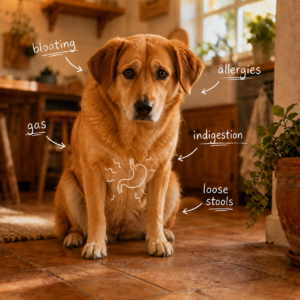
Every few weeks, something would go wrong. Loose stools. A bout of vomiting. A day where she just didn’t want to eat. Each time, the vet would rule out anything serious and send us home with the same advice: bland diet for a few days, then back to her regular food. She probably just has a sensitive stomach.
I accepted it for a long time. Some dogs are just like that, I told myself.
Then I started asking a different question. Not “how do I manage this?” but “why does this keep happening?”
The answer wasn’t what I expected.
What "Sensitive Stomach" Actually Means
Sensitive stomach is not a diagnosis. It’s a description.
When a vet says your dog has a sensitive stomach, they usually mean one of two things. Either they’ve ruled out a specific medical condition and don’t have a clearer explanation, or they’ve identified that the dog reacts poorly to certain foods or dietary changes. Both are legitimate. Neither tells you why it’s happening.
The label “sensitive stomach” covers a wide range of things — from genuine food allergies, to inflammatory bowel issues, to digestive variability that has no obvious medical cause. It’s a catch-all term that ends many conversations before they really begin.
And in too many cases, the real cause goes unexamined.
The Gut Is Not Just a Tube
To understand why nutrition matters so much for digestive health, it helps to understand what the digestive system actually is.
The digestive tract runs from the mouth all the way to the colon — stomach, small intestine, large intestine. The entire length is lined with a single layer of cells. This lining does two critical things throughout: it processes and absorbs nutrients from food, and it acts as a barrier, keeping bacteria, toxins, and undigested food particles from entering the bloodstream. When this barrier is working well along its whole length, digestion is smooth and the immune system is calm.
When it isn’t — anywhere along that tract — things go wrong.
The lining of the entire digestive tract turns over completely every three to five days. That means the body is constantly rebuilding it from top to bottom, which requires a continuous supply of specific nutrients. Glutamine is the primary fuel for the cells that make up this lining throughout the whole tract — from the stomach wall to the colon. Zinc maintains the tight junctions between those cells — the microscopic seals that keep the barrier intact wherever they occur. Omega-3 fatty acids help resolve inflammation that can damage the lining at any point along the tract. Fibre feeds the beneficial bacteria in the lower gut that support healthy digestion further up the system.
When any of these nutrients are chronically below the level the body needs, the lining of the digestive tract becomes harder to maintain — not just in one place, but throughout. The barrier weakens. Digestion becomes less reliable. The dog becomes more reactive to foods that a well-nourished digestive system would handle without difficulty.
This is not a food allergy. It’s a digestive system that isn’t getting what it needs to stay in good repair.
The Connection to Nutritional Gaps
Here’s where the story from the rest of this series connects.
As we’ve explored in previous articles, many modern dogs — indoor, neutered, lower-energy — eat significantly less food than the nutritional standards in their food were designed for. A food formulated for a K factor of 130 delivered to a dog eating at K 85 means that dog is receiving considerably fewer nutrients than the label was designed to provide.
This affects every system in the body. But the gut is particularly vulnerable because of how continuously it demands nutrition.
A dog with a chronic, low-level shortfall in zinc receives less of the mineral their digestive tract lining needs to maintain its barrier function — from the stomach wall down. A dog not getting enough omega-3s has less of the anti-inflammatory support the whole tract needs to recover from the daily wear of digestion. A dog eating less protein than their body needs has less glutamine available to fuel the constant renewal of digestive tract cells throughout.
The result isn’t dramatic. It’s not the kind of gut failure that triggers a vet visit. It’s a gut that functions — but at reduced capacity. One that manages most days but struggles with variation. One that produces inconsistent stools, reacts to minor dietary changes, and never quite settles into reliable, comfortable digestion.
A sensitive stomach. Or so it gets labelled.
Why Restricting the Diet Doesn't Fix It
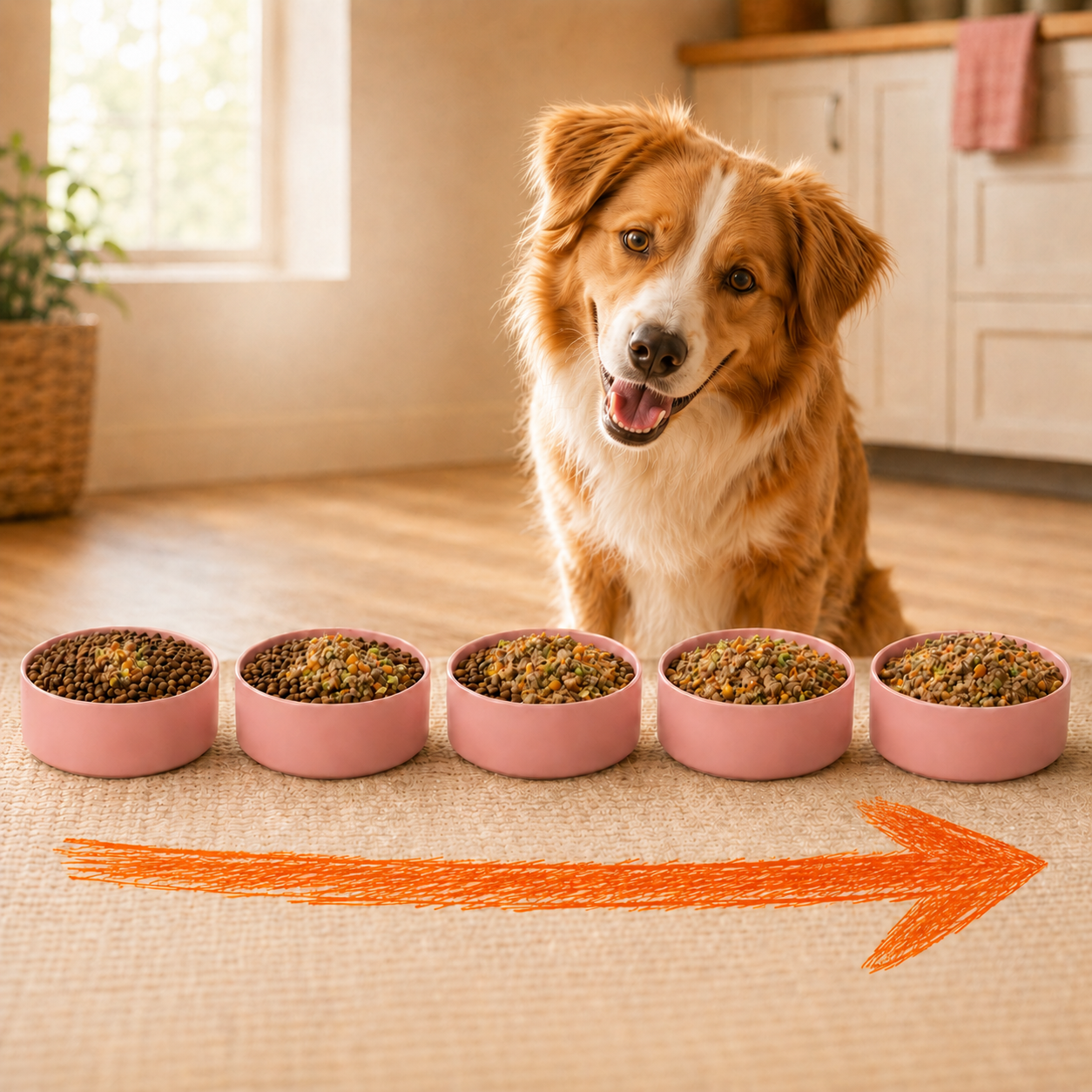
When a dog is identified as having a sensitive stomach, the standard advice is to simplify and restrict. A limited ingredient diet. A single protein source. Plain food, no variety, no changes.
This approach makes sense as a short-term management strategy. Removing potential irritants reduces the chance of triggering a reaction. The dog seems more settled.
But here’s the problem: if the underlying cause is a nutritional gap rather than a true food allergy, dietary restriction makes it worse. A limited ingredient diet is almost always a lower-nutrient diet. Fewer ingredients means fewer opportunities to deliver the full range of vitamins, minerals, and fatty acids the whole digestive tract needs to repair itself.
The dog feels better temporarily — because the trigger has been removed. But the gut lining continues to be under-resourced. The next trigger, whatever it is, produces the same reaction. The owner restricts further. The cycle continues.
True food allergies exist and are a real cause of digestive distress in some dogs. But they are often less common than the sensitive stomach label suggests — and in many cases, what looks like a food allergy is a gut that has become reactive because its barrier function has been compromised by nutritional insufficiency.
What the Gut Actually Needs — and Why Balance Matters
If a nutritional gap is contributing to your dog’s digestive issues, the path forward is not restriction — it’s replenishment. And not just of one nutrient, but of the full range the gut depends on — in the right amounts and the right proportions.
This is where it gets important: the gut doesn’t just need nutrients. It needs them in balance. Too much of one thing can interfere with another. Too little of several things at once compounds the problem. The gut is a system, and it needs to be fed like one.
Protein and glutamine. The entire digestive tract lining runs on protein. Digestive tract cells renew themselves every three to five days, and that process requires a continuous supply of amino acids — particularly glutamine, which is the primary fuel for cells throughout the stomach, intestines, and colon. A diet with high-quality, digestible animal protein provides this consistently. Human-grade proteins are especially valuable here because their digestibility is higher, meaning more of what’s eaten actually reaches where it’s needed.
Zinc — but not in isolation. Zinc is critical for maintaining the tight junctions between cells throughout the digestive tract lining — the seals that keep the barrier intact from the stomach all the way to the colon. But zinc doesn’t work alone. It interacts with copper, and an excess of zinc can actually deplete copper. The right amount of zinc matters. So does the balance between zinc and copper. Chelated forms of both minerals — zinc gluconate, copper chelate — are absorbed more effectively than inorganic forms, and a well-formulated food accounts for this ratio rather than simply maximising one.
Omega-3 fatty acids and the omega-6 balance. EPA and DHA from sources like Atlantic mackerel and flaxseed help resolve the low-grade inflammation that accumulates in the gut over time. But here too, balance matters. Omega-6 fatty acids are pro-inflammatory in excess; omega-3s are anti-inflammatory. The ratio between them in the diet influences how well the gut can resolve inflammation and recover from daily wear. A diet with too much omega-6 and too little omega-3 keeps the gut in a low-grade inflammatory state even when individual nutrient levels look adequate.
Vitamin D. Dogs cannot synthesise vitamin D from sunlight the way humans can. They depend almost entirely on dietary intake. Vitamin D plays a role in gut barrier function, immune regulation, and calcium absorption — and its relationship with calcium and phosphorus means that getting it wrong in one direction affects the others. Too little vitamin D impairs calcium absorption. Too much causes problems of its own. The level and its interaction with other minerals needs to be calibrated, not just present.
B vitamins. The B vitamin group — including B6, B12, folate, and riboflavin — supports energy metabolism in gut cells, healthy nerve function in the digestive tract, and the production of red blood cells. Deficiencies here tend to show up subtly: slightly reduced gut motility, inconsistent digestion, mild fatigue. They are often overlooked precisely because their absence doesn’t produce obvious symptoms.
Fibre — the right kind and amount. Soluble fibre feeds the beneficial bacteria in the gut that produce short-chain fatty acids — particularly butyrate, which is a primary energy source for the cells lining the colon. Psyllium husk, acacia fibre, and vegetables like pumpkin provide this prebiotic support. But fibre also needs to be balanced: too little and the microbiome is under-resourced; too much and digestion becomes unpredictable. The type of fibre matters as much as the quantity.
The point about balance. A gut that receives adequate protein but low zinc has a weakened barrier even with good building material. A gut with good zinc and omega-3s but poor fibre lacks the microbiome support it needs to stay resilient. Each nutrient supports the others. A shortfall in one reduces the effectiveness of the rest.
This is why simply adding a supplement or switching to a limited ingredient diet rarely resolves a sensitive stomach for good. The gut needs the full picture — every nutrient, in the right amounts, in the right proportions — delivered consistently at the level the dog actually eats.
The Question Worth Asking
Before accepting “sensitive stomach” as a permanent feature of your dog’s life, it’s worth asking a more specific question.
Is your dog’s food actually delivering the nutrients their gut needs — at the amount your dog actually eats?
Not the reference dog on the label. Your dog. At their actual calorie intake, their actual activity level, their actual size and metabolic rate.
Because if your dog is eating significantly less than the food was formulated for, their gut is receiving less zinc, less protein, less omega-3, less of everything the lining needs to stay healthy and resilient. Not dramatically less — but consistently, chronically less. Day after day. Week after week.
A sensitive stomach that keeps coming back despite a careful, well-intentioned diet may not be a sensitivity at all. It may be a gut that is quietly, persistently under-resourced.
And a gut that is properly nourished — with the right nutrients, at the right density, calibrated to what that dog actually eats — is a gut that can repair itself, maintain its barrier, and handle the minor variations of daily life without complaint.
That’s not a sensitive stomach. That’s a dog whose food was finally built for them.
References
Gut barrier function and nutritional requirements
1. Camilleri M et al. (2024). Intestinal barrier impairment, preservation, and repair: an update. PMC/NIH. https://pmc.ncbi.nlm.nih.gov/articles/PMC11509958/ Intestinal permeability is reduced by nutrients including glutamine, zinc, vitamin D, fibre, and omega-3 fatty acids.
2. Bonza Dog (2026). The gut-immune axis in dogs — how gut health supports immune health. https://www.bonza.dog/2026/01/gut-immune-axis-in-dogs/ Zinc, glutamine, and omega-3 fatty acids identified as key nutrients for maintaining intestinal barrier integrity in dogs.
IVC Journal (2024). A nutritional approach to leaky gut syndrome in dogs and cats. https://ivcjournal.com/a-nutritional-approach-to-leaky-gut-syndrome-in-dogs-and-cats/ Omega-3 fatty acids and zinc carnosine support gut barrier function and microbiome modulation in dogs.
Nutrient balance and gut health
4. Summers SC, Stockman J et al. (2021). Calcium, phosphorus, and vitamin D in dogs and cats: beyond the bones. Veterinary Clinics: Small Animal Practice. https://pubmed.ncbi.nlm.nih.gov/33653533/ Calcium, phosphorus, and vitamin D interact closely — imbalances in one affect the others. Balance between these nutrients is as important as individual levels.
5. Merck Veterinary Manual. Nutritional requirements of small animals. https://www.merckvetmanual.com/ management-and-nutrition/nutrition-small-animals/nutritional-requirements-of-small-animals Calcium and phosphorus must be balanced relative to each other; optimal Ca:P ratio in dogs is approximately 1.2–1.4:1. Vitamin D governs intestinal absorption of both.
6. Camilleri M et al. (2024). Intestinal barrier impairment, preservation, and repair: an update. PMC/NIH. https://pmc.ncbi.nlm.nih.gov/articles/PMC11509958/ Intestinal permeability is reduced by a combination of nutrients including glutamine, zinc, vitamin D, fibre, and omega-3 fatty acids — no single nutrient acts alone. Choosing a complete and balanced diet helps eliminate sensitive stomachs that result from nutritional deficiencies.
7. Big Dog Pet Foods. What to feed a dog with a sensitive stomach. https://www.bigdogpetfoods.com/guides/what-to-feed-a-dog-with-a-sensitive-stomach Poor gut barrier function — including leaky gut syndrome — identified as a common but under-recognised cause of food sensitivities in dogs.
NRC framework and nutrient adequacy
8. German AJ et al. (2015). Assessing the adequacy of essential nutrient intake in obese dogs undergoing energy restriction for weight loss. BMC Veterinary Research. https://pmc.ncbi.nlm.nih.gov/articles/PMC4597434/
9. National Research Council (2006). Nutrient Requirements of Dogs and Cats. National Academies Press. https://books.google.com/books?id=aqeCwxbRWvsC
Social Share