


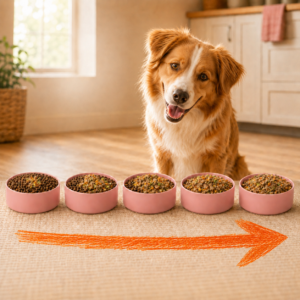
Day three and the stools were a disaster. Day five and I was googling “is my dog allergic to his new food.” By day eight I’d given up and gone back to the old food, convinced the new one just didn’t agree with him.
I tried again three months later. Same thing happened.
It wasn’t until I actually understood what was going on inside my dog’s body during a food change that everything clicked. The problem wasn’t the food. The problem was that I — like most dog owners — had no idea what a real diet transition actually involves.
Here’s what I wish someone had told me from the start.
The 7–14 Day Transition Advice Is Only Half the Story
You’ve probably seen it on every bag of dog food: transition over 7 to 14 days. Start with 25% new food, work up to 100%, done.
This advice isn’t wrong exactly. But it was written for a very specific situation — switching between two similar foods. Same format, similar ingredients, similar amounts of protein, fat, and carbohydrate. In that case, the body doesn’t have to change much. Just swap the flavour, essentially.
But switching from a standard carbohydrate-heavy diet — like most kibbles — to a high-protein, high-fat food like freeze dried or raw? That’s a completely different situation. The body isn’t just adjusting to new ingredients. It’s shifting to a fundamentally different way of processing nutrients and producing energy.
That kind of change takes much longer than two weeks. And when owners don’t know this, they interpret the normal signs of adaptation as signs that something is wrong — and give up.
What's Actually Happening Inside Your Dog
When you increase protein and fat and reduce carbohydrates, two major systems in your dog’s body have to adapt. They adapt at different speeds, which is exactly why transitions can feel inconsistent.
The gut bacteria shift first — and quickly.
Your dog’s gut is home to billions of bacteria. Different bacteria thrive on different foods. When protein increases, the balance of bacteria shifts to favour those that break down protein.
In the early stages of transition, your dog’s small intestine isn’t yet fully efficient at digesting the higher protein load. This means more undigested protein reaches the large intestine than usual, where bacteria ferment it. The byproducts of this process can irritate the gut lining and affect how much water stays in the stool.
The result? Softer stools, different-smelling stools, sometimes loose stools. Not because the food is wrong. Because the gut is adapting.
This part usually settles within one to two weeks as protein digestion becomes more efficient and the bacterial balance stabilises.
Fat digestion takes much longer.
Fat is the slowest thing to adapt to. Digesting fat properly requires bile from the liver, enzymes from the pancreas, and absorption through the gut lining — all working together in a coordinated way.
When dietary fat increases significantly, the body needs time to ramp up bile production, increase enzyme activity, and improve how efficiently fat is absorbed. This doesn’t happen in a week or two. Research shows this process can take several weeks — sometimes longer.
During this time, undigested fat can still reach the large intestine, drawing in water and softening stools. Bile acids that aren’t fully reabsorbed can also stimulate the gut to move things through faster.
This is often the phase where owners give up. The gut bacteria have settled, things seemed to be improving — and then stools soften again. It feels like a setback. In reality, it’s the fat adaptation phase doing its thing.
The Signs to Watch — and What They Mean
The single most reliable signal during a food transition is stool quality.
Firm, well-formed stools mean the body is handling the current ratio of old to new food well. Keep going.
Slightly softer stools mean the body is working hard to adapt. Slow down — don’t increase the proportion of new food until things firm up.
Noticeably loose or watery stools mean the digestive system is under real stress. Stop progressing. Consider a 24-hour fast (water only) to give the gut a rest, then return to the last ratio that produced firm stools. Stay there until things stabilise.
This is not a failure. It is the body telling you it needs more time at this stage.
The 30-Day Plan — Used Loosely
A 30-day transition is a better starting point than 7–14 days, but even that isn’t a fixed rule. The actual timeline depends on how big the dietary shift is and how your individual dog responds.
Some dogs transition smoothly in three weeks. Others take six to eight weeks, or longer. Both are normal.
What matters is not following a calendar. It’s watching your dog’s body and moving at the pace it can handle.
A rough guide:
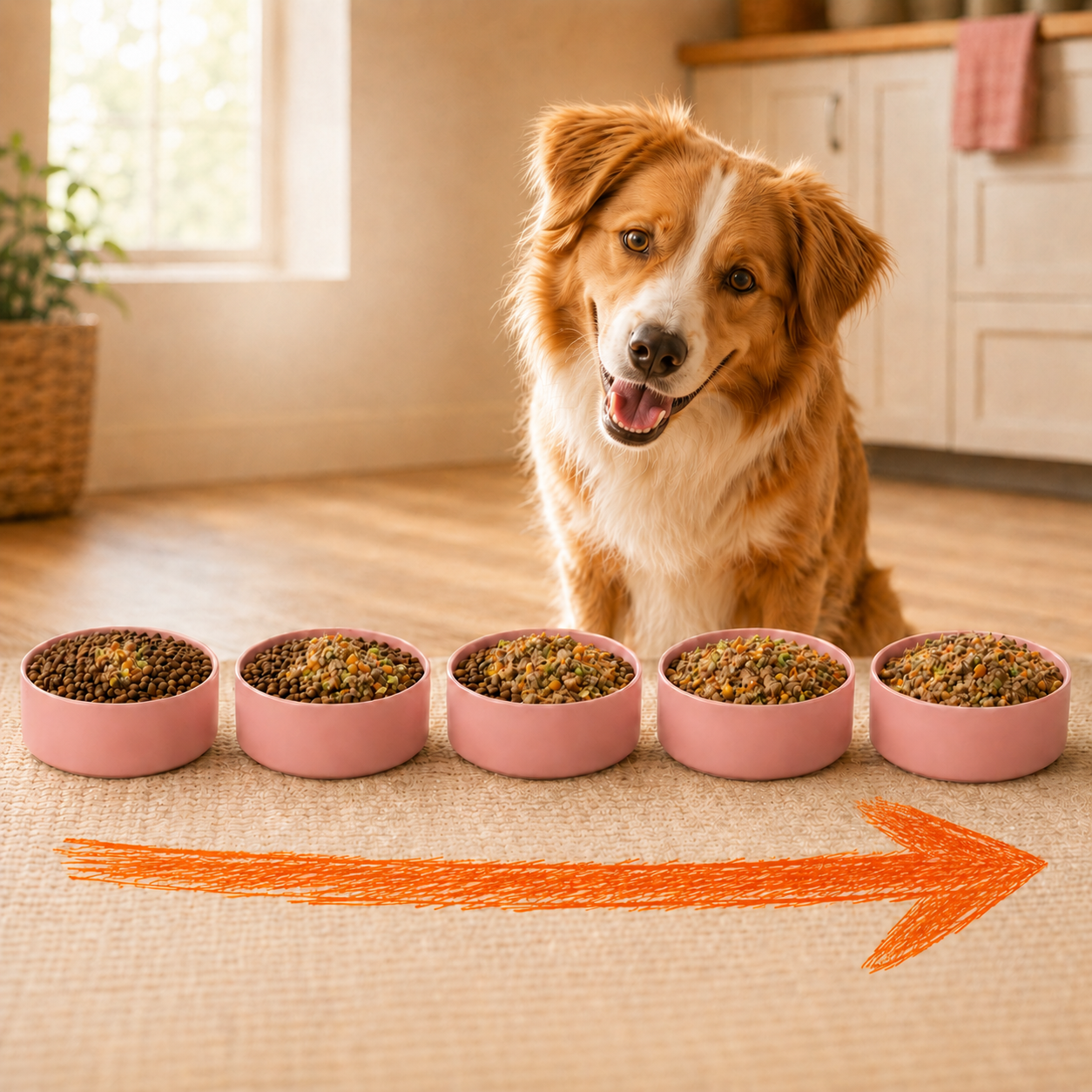
Week 1–2: 25% new food, 75% old. Give the gut microbiome time to begin shifting. Expect some variation in stools — this is normal.
Week 2–3: 50% new, 50% old. Only move here when stools are consistently firm. If not, stay at 25% longer.
Week 3–4: 75% new, 25% old. Fat digestion is now the main challenge. Be patient. Stools may soften again — this is the fat adaptation phase.
Week 4 onwards: 100% new food. But “complete” doesn’t always mean “fully adapted.” Full metabolic adaptation — where the body is efficiently using fat as its primary fuel — can take 4 to 12 weeks from when the transition started.
Why Your Dog Might Seem Hungrier or More Unsettled
Here’s something that surprises a lot of owners during transition: a dog that’s eating more food than before but seems hungrier, or more restless, or slower to settle.
When the body is shifting from running primarily on carbohydrates to running primarily on fat and protein, there’s a period where it isn’t yet efficient at the new system. The old fuel is reduced. The new one isn’t fully operational yet. Energy can feel less stable during this window.
This is temporary. As fat metabolism adapts — which takes the longest — the body settles into a more consistent energy state. Many owners notice their dog becomes calmer, more sustained in energy through the day, and less food-focused once full adaptation is reached.
But in the middle of transition, it can feel like the new food is making things worse. It isn’t. The body is just between systems.
What to Do If You're Starting Again
If you’ve tried a transition before and it didn’t work — you’re not starting from zero. Your dog’s body has already begun some of the adaptation. Going back to the old food pauses the process; it doesn’t erase it.
When you start again:
Go slower than you think you need to. If the previous attempt fell apart around 50% new food, start your next attempt at 25% and stay there for longer before progressing.
Watch stools, not the calendar. Don’t move to the next stage based on how many days have passed. Move when stools are consistently firm.
Expect the fat phase. Know that around week three or four, when fat intake is higher and the gut bacteria have mostly settled, stools may soften again. This is the fat adaptation phase — not a reason to stop.
Don’t add other changes at the same time. Treats, toppers, and supplements all introduce new variables during an already variable process. Keep everything else constant while the transition is underway.
The Payoff
A proper diet transition is slower and more involved than most guidance suggests. But it’s worth understanding why it’s slow — because once you do, you stop interpreting every loose stool as a failure and start reading it as information.
The body is adapting. The gut is reorganising. The energy system is shifting.
When that adaptation is complete, most owners notice real differences. Better stool consistency and volume. A coat that looks improved. Steadier energy through the day. A dog that seems more settled and less food-fixated.
None of that happens in two weeks. But it does happen — as long as you give the body the time it actually needs.
Social Share