





Every pet parent wants to feed their dog well and support a long, healthy life. And for many, the label “complete and balanced” feels like a clear answer.
But what if that answer depends on something rarely discussed?
All dog food standards are based on how much a dog is expected to eat. Most modern dogs live quite differently. They are less active, often neutered, and usually eat less than these standards suggest.
Here’s why this matters.
Dogs eat to meet their energy needs, but their body still needs the same essential nutrients. When a dog eats less food, it also gets fewer nutrients—even if the food meets a recognised standard.
This creates a gap that isn’t easy to see. Your dog might look healthy and keep a steady weight, but there could be a hidden nutritional gap, often without clear signs.
Because the real question isn’t whether a food is “complete and balanced”—it’s whether it’s complete and balanced for your dog.
1. Introduction
Every pet parent wants to do the right thing—feed their dog well, support their health, and give them the best chance at a long life. And in today’s world, that decision often starts with one simple question:
Is this food “complete and balanced”?
It sounds like a clear answer. But in reality, it’s only part of the story.
Because nutrition isn’t just about whether a food meets a standard. It’s about whether that food delivers the right amount of nutrients for your dog.
And that depends on two things most pet parents are never told to think about: how much nutrition your dog needs, and how much food your dog actually eats.
These are not the same.
This article is designed to help you understand both.
In Section 2, we explain what “complete and balanced” really means—and what it doesn’t.
In Section 3, we look at why nutritional standards were created in the first place.
In Section 4, we break down the science from the NRC, which defines what nutrients dogs actually need.
In Sections 5 and 6, we explain how AAFCO and FEDIAF translate this science into practical nutritional standards.
From there, we shift the focus to your dog.
In Sections 7 and 8, we explain how energy intake, metabolic weight, and nutrient intake are connected.
In Section 9, we show you how to assess your own dog’s needs step by step.
In Section 10, we explain when these nutritional standards actually apply—and when they don’t.
And in Section 11, we bring it all together to reveal the gap between standard assumptions and how modern dogs actually live.
If you’re here to understand how nutritional standards work, the early sections will help. If you want to understand what your dog actually needs, the later sections are where it matters most.
Because the real question isn’t whether a food is “complete and balanced”—it’s whether it’s complete and balanced for your dog.
2. What “Complete and Balanced” Really Means
Section Summary
Section 2 explains what “complete and balanced” really means. It refers to diets that meet established nutritional standards. This ensures all essential nutrients are present in the right proportions when fed as the sole diet. This can be achieved through formulation or feeding trials. While it provides a reliable baseline for preventing deficiencies. It does not guarantee the right intake for every dog. Actual nutrient consumption depends on how much the dog eats and the nutrient density of the diet.
The phrase “complete and balanced” is one of the most widely used claims in dog nutrition. It appears on packaging, websites, and marketing materials—and for many pet owners, it serves as a signal of trust.
But this phrase has a very specific meaning.
A “complete and balanced” diet for a dog gives all the essential nutrients it needs in the right amounts. It should be the only source of nutrition for a dog over time. If a dog eats only that food, it should receive sufficient amounts of all essential nutrients to support health.
2.1 How Is “Complete and Balanced” Defined?
This claim is not arbitrary. It is linked to established nutritional standards. In the US, the Association of American Feed Control Officials (AAFCO) usually sets these. In Europe, the European Pet Food Industry Federation (FEDIAF) does.
A product can qualify as “complete and balanced” in two main ways:
1. Formulation Approach
In the formulation approach, we calculate the nutritional content of dog food. Then, we compare it to a recognised nutritional standard. Manufacturers start by checking the amount of each key nutrient, like protein, amino acids, vitamins, and minerals, in the recipe. They use ingredient composition, nutrient databases, and lab analysis for this. These calculated values are then measured against the required levels defined by standards such as AAFCO or FEDIAF.
If the formulation meets or exceeds all nutrient levels and stays within safe limits, the food is considered to be “complete and balanced.”
These requirements are typically expressed in two ways. Nutrients are often measured based on energy intake, like per 1,000 kilocalories. This means that as a dog eats to meet its energy needs, nutrient intake should increase too. Nutrients can also be shown on a dry matter (DM) basis. This takes out the impact of water content. It lets us compare foods with different moisture levels, like kibble, fresh diets, or freeze-dried products.
The formulation approach is a clear, step-by-step process. It checks if a recipe’s nutrient makeup meets set nutritional standards.
2. Feeding Trials
The second method used to establish whether a dog food is “complete and balanced” is through feeding trials.
Feeding trials differ from the formulation approach. Instead of just checking nutrient levels on paper, they see how food works when dogs eat it. In this method, a group of dogs is fed the diet as their sole source of nutrition over a defined period. Protocols established by the Association of American Feed Control Officials (AAFCO) need to be followed.
Under AAFCO guidelines, adult maintenance feeding trials usually last at least 26 weeks, or about 6 months. During this time, we monitor dogs for important health signs. This includes body weight, physical condition, and specific clinical parameters like blood values. If the dogs maintain normal health throughout the study period. The food is considered to meet AAFCO’s requirements for nutritional adequacy.
This feeding trial pathway is a distinctive feature of the AAFCO system.
In contrast, the European Pet Food Industry Federation (FEDIAF) does not provide a similar standardised feeding trial protocol to substantiate nutritional adequacy claims. Instead, FEDIAF places primary emphasis on formulation against its published nutrient guidelines, which are derived from scientific data, including work from the NRC and other sources.
Feeding studies can still happen in Europe for research or product development. However, they aren’t the main way to define a product as “complete and balanced” under FEDIAF guidelines.
This distinction is important.
Feeding trials add a useful layer of validation. They capture things like nutrient bioavailability and actual intake. However, they are conducted over a defined timeframe and on a limited number of animals. This could also mean they may not detect longer-term or more subtle imbalances.
In essence, the two approaches reflect different ways of establishing adequacy. Formulation evaluates whether a diet meets defined nutrient requirements. Feeding trials prove whether the diet maintains health when fed over a defined period of time.
2.2 What “Complete and Balanced” Guarantees — and What It Doesn’t
The claim “complete and balanced” provides an important baseline in dog nutrition, but it is often misunderstood.
At its core, this claim means that a diet contains all essential nutrients required by a dog. The nutrients are within certain amounts that meet established nutritional standards. These standards come from regulatory groups like the Association of American Feed Control Officials (AAFCO) in the US and the European Pet Food Industry Federation (FEDIAF) in Europe. The specific standards depend on where the product is sold.
When a food meets these standards, it aims to provide enough protein, fats, vitamins, and minerals for normal health as the only diet.
This is an important safeguard. It makes sure that store-bought foods provide all the essential nutrients and helps stop clear deficiencies.
However, the claim has its limits.
“Complete and balanced” does not mean that all foods are nutritionally the same. Recipes vary in ingredient quality and nutrient density. They also differ in how they deliver nutrients relative to how much a dog eats.
It also does not mean the diet is perfectly suited to every individual dog. These standards are designed to ensure adequacy across a broad population. The standards are not defined to precisely match the needs of every dog under different conditions.
Because many nutrients are defined relative to energy intake, how much a dog eats also matters. Differences in appetite, metabolism, and lifestyle can influence how closely a diet matches a dog’s actual needs.
In simple terms, “complete and balanced” ensures that a food meets a recognised nutritional standard. It provides a reliable baseline—but not a precise fit for every dog.
3. Why Nutrition Standards Exist
To understand modern dog nutrition standards, it helps to first understand why they were needed in the first place.
Section Summary
This section explains why nutritional standards were developed. Feeding shifted from varied, home-based diets to commercial foods, and then to commercially prepared meals. Dogs began relying on a single product for all their nutrition. This removed the natural balance created by dietary diversity, making any imbalance more impactful over time. Early poorly formulated diets led to visible health issues, driving research to define essential nutrient requirements. These findings were turned into clear nutritional standards. This ensures consistency, safety, and basic nutritional adequacy in commercial dog foods.
3.1 The Shift to Commercial Diets
For most of history, dogs were not fed formulated diets. They lived alongside humans and consumed a mix of table scraps, raw ingredients, and whatever food was available. Nutrient intake varied from day to day, but this variability was part of a broader, mixed diet.
The rise of commercial pet food changed this completely.
As societies urbanised and more people moved into cities, lifestyles began to shift. With busier routines and less time for food preparation. There was a growing demand for convenience, not just for people, but for how they fed their pets.
Feeding slowly moved to commercial diets that are convenient, shelf-stable, and easy to use. Dogs increasingly began relying on a single product as their primary—or sole—source of nutrition.
This created a new challenge: the diet itself now had to provide everything the dog needed, consistently, every day.
Unlike a varied diet, a fixed diet removes the natural buffering effect of diversity. Any imbalance—whether too little or too much of a nutrient—can persist daily and accumulate over time.
This shift made standardisation essential.
3.2 The Risk of Nutrient Deficiencies
Early in the development of commercial pet foods, poorly balanced diets led to clear and sometimes severe health problems.
These included skeletal problems from calcium and phosphorus imbalances. Rickets from vitamin D deficiency. Heart issues in some formulations missing key nutrients. Poor growth, coat quality.
Impaired immune function due to vitamin and mineral shortages and many others.
These were not subtle effects. They were clinically visible, often severe, and directly linked to nutritional imbalance.
Early work in animal nutrition aimed to find the least amount of each essential nutrient needed. It focused on the levels required to prevent deficiency symptoms and the safe upper limits to avoid toxicity.
This body of research formed the foundation of modern nutrient requirement systems.
3.3 From Science to Standards
Scientific research gives data in controlled settings. It focuses on individual nutrients, tracks intake, and looks at physiological results. However, translating this knowledge into practical feeding systems requires additional layers of interpretation.
Dogs vary widely in size, breed, and metabolism. They also differ in activity levels and physiological states. Food intake isn’t fixed. Diets should be practical for production, storage, and consistent feeding.
To bridge this gap, we developed structured frameworks.
4. The Scientific Foundation — National Research Council (NRC)
Section Summary
This section explains the scientific foundation of dog nutrition through the NRC. It defines what nutrients dogs need, how much they require, and the level of evidence behind those requirements. These needs are based on the dog’s biology and metabolic body weight, not the food itself. It also explains how nutrient intake is linked to energy intake—dogs eat to meet energy needs, which determines how much nutrition they receive. The NRC provides the scientific reference, while standards like AAFCO and FEDIAF apply this in practical feeding.
4.1 What is the NRC?
The National Research Council (NRC) is a scientific body that evaluates and synthesises research across a wide range of disciplines, including animal nutrition. In pet nutrition, its role isn’t to regulate or enforce standards. Instead, it focuses on setting evidence-based nutrient needs using scientific data.
For dogs and cats, these requirements are published in Nutrient Requirements of Dogs and Cats (2006), which is widely regarded as the foundational reference in companion animal nutrition.
This publication forms the scientific basis upon which most modern feeding standards are built.
4.2 How the NRC Defines Nutrient Requirements
The NRC approaches nutrition from a biological perspective. Rather than starting with foods or formulations, it focuses on the fundamental question:
What nutrients does a dog need to maintain normal physiological function?
The NRC gathers data from controlled feeding studies, nutrient balance experiments, and dose–response trials to answer this. Where direct evidence is limited, it also uses scientific extrapolation and comparative data to establish reasonable estimates.
This process reflects a key reality in nutrition science: not all nutrients have the same level of evidence. Some requirements are supported by well-defined experimental data, while others are based on observed intake levels or inferred from related research.
The NRC makes these distinctions explicit through its classification system.
4.3 How Nutrient Requirements Are Determined
Determining nutrient requirements is not a single-step process. It involves a combination of controlled experimentation, observation, and scientific interpretation.
One main method is the dose–response approach. In this method, animals receive higher levels of a specific nutrient. This helps find the point where deficiency symptoms stop and normal function returns. Some cases use depletion–repletion studies. In these, a nutrient is restricted and then gradually reintroduced to observe recovery.
These methods help establish the minimum requirement (MR) for a nutrient under controlled conditions.
However, not all nutrients can be studied in this way. Ethical issues, long study times, and complex biology often limit direct experimental data. In these cases, the NRC uses observed intake levels from healthy animals. They also look at data from related species or life stages to set the adequate intake (AI).
Real-world conditions can vary. This includes differences in digestibility, ingredient quality, and individual physiology. So, the recommended allowance (RA) adds a safety margin above the minimum requirement or adequate intake.
This layered approach reflects both the strengths and limitations of nutrition science.
4.4 Understanding MR, AI, and RA
One of the most important contributions of the NRC is the way it categorises nutrient requirements based on both evidence and biological need.
Minimum Requirement (MR) The minimum requirement is the least amount of a nutrient needed to meet dogs’ needs in controlled tests. It is typically derived from dose–response studies and reflects the level at which deficiency symptoms are prevented.
Adequate Intake (AI) When there isn’t enough data to find a clear minimum need, the NRC sets an adequate intake. This is based on the intake levels seen in healthy animals. These levels are enough to support normal body function.
Recommended Allowance (RA) The recommended allowance is the most practical reference point. It adds a safety margin to the minimum requirement or adequate intake. This margin considers differences in nutrient digestibility, ingredient composition, and individual dogs.
In practical terms, the RA represents a level of intake that is expected to meet the needs of most dogs under typical conditions.
4.5 How the NRC Expresses Nutrient Requirements
In addition to defining nutrient requirements, the NRC also provides multiple ways of expressing these requirements. This is important because nutrient needs can be interpreted differently depending on whether the focus is on the composition of the food, the amount consumed, or the biology of the animal.
Within Nutrient Requirements of Dogs and Cats (2006), nutrient requirements are commonly presented in three formats:
- Per kilogram of dry matter (DM)
- Per 1,000 kilocalories of metabolisable energy
- Per unit of metabolic body weight (kg⁰·⁷⁵)
- Each of these serves a different purpose.
Values expressed on a dry matter basis describe the concentration of nutrients in the food itself. This lets you compare diets with different moisture levels, like kibble, fresh food, or freeze-dried products.
Values expressed per 1,000 kilocalories relate nutrient intake to energy consumption. Dogs mainly eat to meet their energy needs. This format helps estimate how much of each nutrient a dog gets based on its food intake.
Values shown as metabolic body weight indicate the animal’s biological needs. This allows nutrient needs to be scaled appropriately across dogs of different sizes.
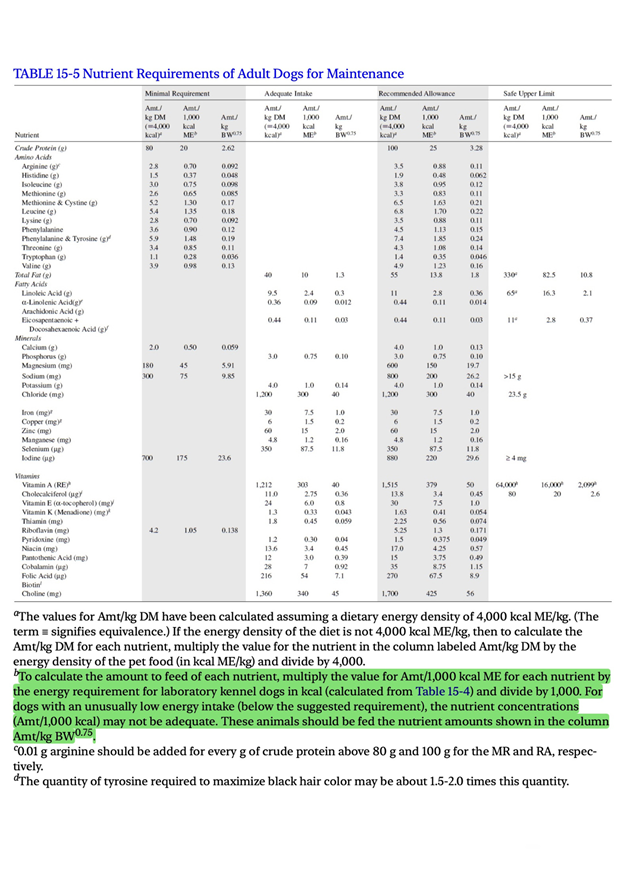
Source: National Research Council (2006), Nutrient Requirements of Dogs and Cats, p. 290. This excerpt is used for educational purposes. All rights belong to the original publisher.
The table above shows how different systems express the same nutrient needs.
While the underlying requirement remains the same, the way it is presented changes the perspective. Dry matter values show how concentrated the food is. Energy-based values reflect how much is consumed. Metabolic body weight values relate to the animal’s biological needs.
Understanding these different representations is crucial. They form the foundation for translating nutrient needs into practical feeding standards.
4.6 The Role of Energy in Nutrient Requirements
An important concept within the NRC framework is that nutrient requirements are closely linked to energy intake.
Dogs do not consume nutrients in isolation—they eat food to meet their energy needs. As a result, the total amount of nutrients a dog receives depends on how much food it consumes, which is driven primarily by its energy requirement.
The NRC sees this link and gives energy need estimates based on body weight, life stage, and health status. These estimates help us see how much of each nutrient a dog gets based on their food intake.
4.7 Metabolisable Energy (ME) and Nutrient Intake
Energy needs in the NRC framework are shown as Metabolisable Energy (ME). This measures the energy in food that animals can use, after considering losses from digestion and metabolism.
Because dogs eat to meet their energy needs, food intake is largely determined by ME requirements. This creates a direct relationship between energy intake and nutrient intake.
Nutrient intake = Nutrient concentration × Food intake (driven by energy needs)
In practical terms, this means that even if a food meets defined nutrient levels, the actual amount of nutrients a dog receives depends on how much of that food it consumes.
The NRC presents nutrient requirements alongside energy estimates to reflect this relationship, allowing nutrient intake to be interpreted in the context of expected food consumption.
This connection between energy intake and nutrient delivery is fundamental to how nutritional standards are applied in practice. It also explains why many regulatory frameworks later express nutrient requirements relative to energy—such as per 1,000 kilocalories—rather than as fixed daily amounts.
4.8 Why the NRC Framework Matters
The NRC provides the scientific foundation for modern dog nutrition.
It defines what nutrients dogs require, how much they need, and the level of evidence supporting those requirements. It does this by connecting nutrient needs to physiology and metabolic body weight from a biological angle.
However, the NRC does not prescribe how diets should be formulated or regulated in practice. It does not create commercial standards or approve pet foods.
Instead, it provides the underlying reference framework.
Regulatory systems like AAFCO and FEDIAF build on this. They turn scientific nutrient needs into clear standards for commercial diets.
This distinction is critical.
The NRC defines what a dog needs. Regulatory frameworks define how those needs are applied in food.
Seeing this separation helps us understand nutrient needs versus feeding standards. It shows how these standards are applied and where they fall short.
These frameworks link scientific knowledge to real-world use.
4.9 What the NRC Provides — and What It Doesn’t
The NRC offers a scientific framework for nutrient needs. However, it doesn’t dictate how to create or manage diets in practice.
It does not:
- Define regulatory standards
- Approve or certify commercial foods
- Provide ready-to-use nutrient profiles for manufacturing
It offers the basic scientific reference—a list of nutrient requirement values based on research.
This distinction is important.
The NRC answers the question:
What nutrients are essential, and in what amounts, based on current scientific understanding?
It does not answer:
How should these requirements be translated into a commercial diet that can be produced, regulated, and fed consistently?
That translation is the role of regulatory frameworks such as AAFCO and FEDIAF.
5. Translating Science into Standards — Association of American Feed Control Officials (AAFCO)
Section Summary
This section explains how AAFCO translates scientific nutrient requirements into practical standards used in commercial dog food. Based on NRC data, AAFCO defines nutrient profiles, labelling rules, and methods to establish “complete and balanced” claims through formulation or feeding trials. These standards provide consistency and a baseline level of nutritional adequacy across the industry. However, in simplifying complex relationships between nutrient needs and energy intake, they rely on underlying assumptions that influence how well they apply to individual dogs.
5.1 What is AAFCO?
The Association of American Feed Control Officials (AAFCO) develops model standards for pet food in the United States. These standards are adopted and implemented by state regulatory agencies.
AAFCO defines criteria for labelling pet food as “complete and balanced” and provides guidance on nutrient levels, ingredient definitions, and product labelling.
5.2 The Role of AAFCO in Pet Nutrition
AAFCO translates scientific information—primarily from the National Research Council—into standardised frameworks used in commercial pet food.
Its guidelines cover:
- nutrient profiles
- ingredient definitions
- labelling requirements
- nutritional adequacy statements
- feeding trial protocols
These elements form the basis for how pet foods are formulated, evaluated, and labelled within the AAFCO system.
5.3 AAFCO Nutrient Profiles
AAFCO nutrient profiles define minimum and, in some cases, maximum levels of nutrients required for a pet food to be considered nutritionally adequate.
These values are derived from NRC data and presented in standardised formats.
Nutrient requirements are expressed primarily on an energy basis (per 1,000 kilocalories of metabolisable energy) and are also presented on a dry matter basis (per kg DM).
The energy-based format relates nutrient levels to food intake, while the dry matter basis describes nutrient concentration within the food.
5.4 Demonstrating Nutritional Adequacy
Under AAFCO, a pet food can be labelled as “complete and balanced” using one of two methods: formulation or feeding trials.
In the formulation method, the nutrient composition of a diet is calculated and compared against AAFCO nutrient profiles. If the levels of essential nutrients meet or exceed the specified minimums (and do not exceed maximums where defined), the diet qualifies as nutritionally adequate.
In the feeding trial method, dogs are fed the test diet for a defined period, typically 26 weeks for adult maintenance. During this time, they are monitored for parameters such as body weight, blood values, and general clinical condition. If the dogs remain within predefined acceptable ranges, the diet qualifies for a feeding trial adequacy statement.
The formulation method evaluates nutrient levels in the diet, while feeding trials assess observed outcomes in animals over time. Both methods are recognised within the AAFCO framework as means of substantiating nutritional adequacy.
5.5 How AAFCO Relates to the NRC
AAFCO nutrient profiles are based on data from the National Research Council.
In developing these profiles, NRC values are selected and adapted for practical use. This includes applying safety margins, accounting for nutrient availability, and standardising how nutrient levels are expressed.
Not all elements of the NRC framework are directly carried over. Some values are consolidated, modified, or not included in the final nutrient profiles. This reflects the process of translating a detailed scientific framework into a format that can be applied consistently across commercial pet foods.
These adaptations also take into account factors relevant to the pet food industry, including variability in ingredient composition, differences in digestibility, nutrient losses during processing, and the requirements of large-scale manufacturing.
The resulting profiles provide a standardised reference for evaluating nutrient levels within a commercial and regulatory context.
5.6 From Scientific Framework to Practical Standard
The transition from the NRC to AAFCO represents a shift from science to application.
The NRC defines nutrient and energy requirements based on biology. AAFCO translates these into standardised values that can be consistently applied in commercial pet foods.
In doing so, complex relationships between nutrient requirements, energy intake, and feeding behaviour are simplified into fixed nutrient profiles.
These simplifications make large-scale formulation possible—but they also introduce underlying assumptions that influence how well these standards apply to individual dogs.
Further discussion on these underlying assumptions is covered in later sections.
6. European Nutritional Guidelines — Fédération Européenne de l'Industrie des Aliments pour Animaux Familiers (FEDIAF)
Section Summary
This section explains how FEDIAF provides nutritional guidelines for the European pet food industry, based on the same scientific foundation as AAFCO. It relies primarily on formulation against defined nutrient guidelines rather than standardised feeding trials. While both systems include minimum and some maximum levels, FEDIAF more extensively defines nutrient ranges across a wider set of nutrients. This results in a structured approach to formulation that differs in how nutritional adequacy is established and applied in practice.
6.1 FEDIAF Explained
The Fédération Européenne de l’Industrie des Aliments pour Animaux Familiers (FEDIAF) publishes nutritional guidelines for pet food in Europe. It works like the Association of American Feed Control Officials (AAFCO) in the US. It gives manufacturers a framework to create and label pet foods according to European Union regulations.
FEDIAF guidelines work with EU rules on animal feed. They set out safety, traceability, manufacturing standards, and labelling requirements. Within this regulatory structure, FEDIAF provides the nutritional recommendations used for formulation and compliance.
FEDIAF’s nutrient recommendations, like AAFCO’s, rely on scientific studies, including data from the National Research Council. Nutrient levels are shown in similar ways, like per 1,000 kilocalories of metabolisable energy and per kilogram of dry matter (DM). This helps us understand nutrient levels in relation to energy intake and diet composition.
However, there are important structural differences in how these guidelines are applied.
FEDIAF places primary emphasis on formulation against defined nutrient guidelines. It does not use a standard feeding trial protocol like AAFCO does to prove nutritional adequacy. Feeding studies can still support research or product development. However, they are not the main basis for “complete and balanced” claims in the FEDIAF framework.
Also, AAFCO nutrient profiles set minimum levels and some maximum limits for certain nutrients. In contrast, FEDIAF clearly defines both minimum and maximum levels for a broader range of nutrients. This creates a framework that sometimes offers clearer nutrient ranges instead of just minimum targets.
These differences show two ways to use the same scientific basis. One approach includes feeding trials with formulation, while the other mainly uses set nutrient ranges for formulation.
7. Metabolisable Energy and Its Role in Nutritional Standards
Section Summary
This section explains how energy intake drives how much food a dog eats, and therefore how much nutrition it receives. Since dogs eat primarily to meet their energy needs, nutrient intake is directly tied to food intake. By expressing nutrients relative to energy (per 1,000 kcal), nutritional standards establish a link between energy consumption and nutrient delivery. This allows a single formulation to be used across different feeding amounts, but also means that actual nutrient intake can vary depending on how much a dog eats.
7.1 Why Energy Matters
Dogs eat food to meet their energy and nutrient needs. However, how much they eat mainly depends on their energy requirements.
These energy needs are influenced by factors such as body size, activity level, life stage, and physiological status.
As a result, the total amount of nutrients a dog consumes is closely linked to how much food it eats and therefore to how much energy it requires.
7.2 What is Metabolisable Energy (ME)?
Metabolisable Energy (ME) is the energy in food that animals can use. It considers the energy lost during digestion and metabolism.
It is the standard unit used to describe the usable energy content of pet food and is typically expressed in kilocalories (kcal).
The National Research Council and regulators like AAFCO and FEDIAF all use ME as a key reference point. It links food intake to nutrient delivery.
7.3 Linking Energy Intake to Nutrient Intake
Because food intake is driven by energy requirements, the total amount of nutrients a dog receives depends on how much it eats.
For the same diet, a dog with higher energy needs will consume more food, leading to more nutrients. Conversely, a dog with lower energy needs will eat less food, resulting in fewer nutrients.
This means that the same food can result in different levels of nutrient intake depending on the dog’s energy requirement.
7.4 Why Nutrients Are Expressed Per 1,000 kcal
Expressing nutrients relative to energy intake provides a practical way to align nutrient delivery with feeding behaviour.
When nutrients are defined per unit of energy, the amount of nutrients consumed scales with the amount of food eaten. Dogs that eat more receive more nutrients, while those that eat less receive less.
This approach allows a single formulation to be applied across a wide range of feeding quantities.
8. Relationship Between Energy Intake and Nutrient Requirements
Section Summary
This section starts by explaining nutrient needs. These are based on metabolic body weight (kg^0.75). It also shows how to calculate these needs for dogs of various sizes.
It then explains energy requirements through the K factor. It also shows that dogs of the same size can have different energy needs. It also shows that energy intake varies across and within activity levels.
This section links energy intake to nutrient intake. It shows that if a dog’s diet has a set nutrient density, the nutrients they get depend on how much food they eat. An example shows how different energy intake affects nutrient intake.
The section explains how nutrient standards relate nutrients to energy using a reference intake. It also shows how different frameworks consider variations in energy consumption.
8.1 Understanding the Basis of Nutrient Requirements
Nutrient recommendations are often expressed relative to energy intake, such as per 1,000 kilocalories of metabolisable energy.
Within the framework of the National Research Council, nutrient requirements are also defined independently of energy intake, particularly when expressed relative to metabolic body weight (kg^0.75).
As per the National Research Council, the requirement for essential nutrients in dogs is based on metabolic body weight, expressed as kg^0.75.
This concept reflects the observation that many biological processes—such as metabolism, cellular activity, and tissue maintenance—do not increase in direct proportion to body weight. Instead, they scale more closely with body weight raised to the power of 0.75.
In practical terms, this means that as dogs increase in size, their nutrient requirements do increase, but not linearly with body weight. Larger dogs require more nutrients in total than smaller dogs, but less per kilogram of body weight.
For example, a 20 kg dog does not require twice the nutrients of a 10 kg dog, even though it weighs twice as much. This is because metabolic activity does not double with body weight—it increases at a slower rate.
By expressing nutrient requirements relative to metabolic body weight (kg^0.75), the NRC provides a way to scale nutrient needs across dogs of different sizes based on their underlying physiological activity, rather than just their total body mass.
This approach forms the biological basis for determining how much of each essential nutrient a dog requires on a daily basis.
Energy requirements are addressed separately and determine how much food a dog consumes. As a result, nutrient intake is influenced by energy intake, while nutrient requirements are defined by physiological considerations.
8.2 Calculating Nutrient Requirements Using Metabolic Body Weight
Once nutrient requirements are expressed relative to metabolic body weight (kg^0.75), they can be used to calculate the daily requirement for dogs of different sizes.
Using the National Research Council framework, the phosphorus requirement for adult maintenance can be expressed as approximately:
98 mg per kg BW^0.75 per day
This allows the requirement to be scaled across dogs of different body weights.
For example:
A 5 kg dog has a metabolic body weight of 3.34 kg BW^0.75 and requires approximately 327 mg of phosphorus per day.
A 10 kg dog has a metabolic body weight of 5.62 kg BW^0.75 and requires approximately 551 mg of phosphorus per day.
A 15 kg dog has a metabolic body weight of 7.62 kg BW^0.75 and requires approximately 747 mg of phosphorus per day.
These calculations show that nutrient requirements increase with body weight, but not in direct proportion. Larger dogs require more nutrients in total, but less per kilogram of body weight.
This reflects the biological scaling of nutrient requirements as defined by the National Research Council.
8.3 Understanding Energy Requirements
While nutrient requirements are defined based on metabolic body weight, energy requirements are addressed separately.
Within the framework of the National Research Council, energy needs are estimated based on body weight and adjusted for factors such as activity level, life stage, and physiological status. This variation is represented using a K factor, which reflects a dog’s daily energy intake relative to its metabolic body weight.
As a result, two dogs of the same body weight may have significantly different energy needs. A more active or intact dog may require higher energy intake, while a less active or neutered dog may require lower energy intake.
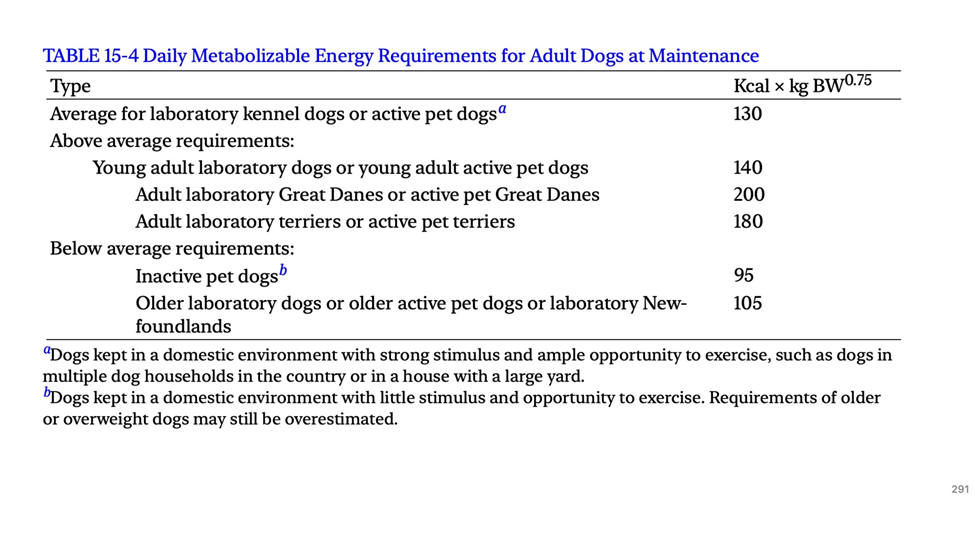
Source: National Research Council (2006), Nutrient Requirements of Dogs and Cats, p. 291. This excerpt is used for educational purposes. All rights belong to the original publisher.
The table above shows the range of energy requirements defined by the NRC across different activity levels. At one end, inactive dogs may require around 95 kcal per kg BW^0.75, while more active dogs may be closer to 130 kcal per kg BW^0.75 or higher.
This provides the basis for understanding K factor differences across dogs.
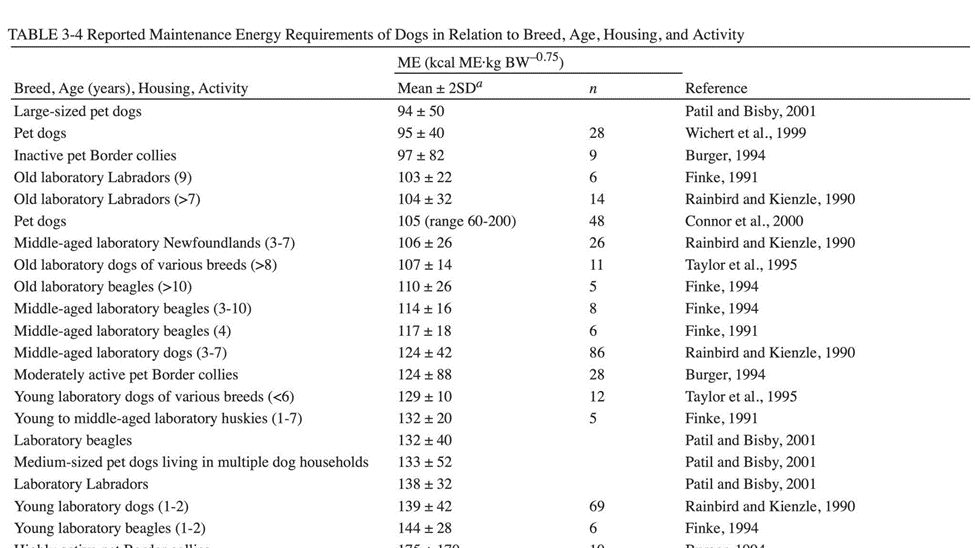
Source: National Research Council (2006), Nutrient Requirements of Dogs and Cats, p. 40. This excerpt is used for educational purposes. All rights belong to the original publisher.
However, even within these categories, energy requirements are not fixed.
The table above shows reported energy intake across different breeds, ages, and living conditions. What stands out is the wide variation within similar groups. Even within comparable life stages or activity levels, energy intake can vary significantly.
This highlights an important point:
K factor is not a fixed value. It varies across individual dogs—even within the same category.
This variability is influenced by factors such as metabolism, environment, level of activity, neuter status, genetics and breed-specific differences.
8.4 Linking Energy Intake to Nutrient Intake
While nutrient requirements are defined by physiology, the amount of nutrients a dog actually receives depends on how much it eats.
For a diet with fixed nutrient density, total nutrient intake is directly determined by food intake. Since food intake is driven by energy requirements, nutrient intake is also driven by energy intake.
An illustrative example makes this clear.
Example: Same Dog Size, Different Energy Intake
Consider two adult dogs that both weigh 15 kg.
Their metabolic body weight is the same:
15^0.75 = 7.62 kg
Now assume:
- Dog A has a K factor of 135
- Dog B has a K factor of 75
Step 1: Calculate Energy Intake
Dog A consumes:
135 × 7.62 = 1,029 kcal/day
Dog B consumes:
75 × 7.62 = 572 kcal/day
Step 2: Potassium Intake from the Same Diet
Assume both dogs are eating the same diet formulated to the AAFCO minimum for potassium, which is:
1.5 g per 1,000 kcal
Now calculate potassium intake:
Dog A:
1.029 × 1.5 g = 1.54 g/day (≈ 1,543 mg/day)
Dog B:
0.572 × 1.5 g = 0.86 g/day (≈ 858 mg/day)
Step 3: NRC Potassium Requirement
Using the NRC recommended allowance:
140 mg per kg BW^0.75 per day
For a 15 kg dog:
140 × 7.62 = 1,067 mg/day
Step 4: Comparison
Dog A consumes approximately 1,543 mg of potassium per day, based on its higher energy intake.
Dog B consumes approximately 858 mg of potassium per day, based on its lower energy intake.
Both dogs have the same physiological requirement of approximately 1,067 mg per day.
This example shows how differences in energy intake lead to differences in nutrient intake when dogs are fed the same diet with a fixed nutrient density.
8.5 The Reference Energy Assumption in Nutritional Standards
When nutrient recommendations are expressed relative to energy intake, they are based on a reference level of energy consumption.
Within the framework of the National Research Council, this reference is derived from the 15 kg adult dog, which is assumed to consume approximately 1,000 kcal per day.
This corresponds to a K factor of approximately 130–132, representing a relatively high level of energy intake within the broader range observed across the dog population.
Using this reference point, nutrient requirements calculated on a metabolic body weight basis are translated into an energy-based expression (per 1000 kcal), allowing them to be applied in diet formulation.
This provides a standardised way to express nutrient concentrations in food.
However, this standardised expression is anchored to a specific feeding level, corresponding to the assumed energy intake of the reference dog.
8.6 How AAFCO and FEDIAF Address Variation in Energy Intake
Both the Association of American Feed Control Officials (AAFCO) and the Fédération Européenne de l’Industrie des Aliments pour Animaux Familiers (FEDIAF) express nutrient recommendations relative to energy intake.
This reflects the relationship between food intake and nutrient intake, where nutrient delivery is linked to how much energy a dog consumes.
However, the two frameworks differ in how they account for variation in energy requirements across dogs.
AAFCO nutrient profiles are derived using the same reference framework as the National Research Council, where nutrient density is anchored to a single assumed level of energy intake. While AAFCO does not explicitly define a K factor, working backwards from the reference dog (15 kg consuming approximately 1,000 kcal per day), this corresponds to a K factor of approximately 130–132.
As a result, AAFCO presents nutrient requirements as a single nutrient density, which is applied across dogs with different energy needs.
FEDIAF, in contrast, explicitly accounts for variation in energy intake by providing nutrient recommendations across different energy levels. These correspond to:
- 95 kcal/kg BW^0.75 (K ≈ 95) → lower energy requirement
- 110 kcal/kg BW^0.75 (K ≈ 110) → higher energy requirement
By doing so, FEDIAF adjusts nutrient density based on different assumed energy intakes, rather than relying on a single reference point.
This results in a framework where nutrient recommendations are aligned to different feeding levels across the dog population, reflecting variation in energy requirements.
9. What This Means for Your Dog
Section Summary
This section applies the concepts to an individual dog. It provides a simple way to evaluate nutrition. This involves figuring out metabolic body weight, calculating daily nutrient needs, measuring calorie intake, and finding the dog’s K factor. It then puts these values alongside nutritional standards. This shows how a dog’s actual energy intake stacks up against the reference assumptions in formulation frameworks.
9.1 A Practical Way to Assess Your Dog’s Nutrition
To assess your dog’s nutrition, you need to answer two questions:
- How much nutrition does your dog need?
- How much food (energy) does your dog consume?
Nutrient requirements are determined using metabolic body weight (kg^0.75).
Energy intake determines how much food your dog eats and is reflected by its K factor.
Because diets have a fixed nutrient density:
How much your dog eats determines how much nutrition it receives.
9.2 How to Calculate Your Dog’s Nutrition and Energy Intake
To apply this in practice, follow four steps.
First, calculate your dog’s metabolic body weight (kg^0.75).
Second, use this to determine how much of each essential nutrient your dog needs per day based on NRC recommendations based on metabolic weight.
Third, determine how many calories your dog actually consumes per day. This requires knowing the caloric density of the food and how much your dog eats daily to maintain stable body weight.
For example, if a food contains 400 kcal per 100 g and your dog maintains weight on 200 g per day, then:
200 g × (400 kcal ÷ 100 g) = 800 kcal per day
Fourth, calculate your dog’s K factor:
K = Daily Calorie Intake ÷ Metabolic Body Weight
For a 15 kg dog:
Metabolic body weight ≈ 7.62
Daily calorie intake = 800 kcal
K = 800 ÷ 7.62 ≈ 105
This reflects your dog’s actual energy intake relative to its size.
9.3 Interpreting This in the Context of Nutritional Standards
Nutritional standards are based on reference energy assumptions.
Formulations aligned with AAFCO correspond to a reference intake of approximately K ≈ 130.
In this example:
- Your dog: K ≈ 105
- Reference used in formulation: K ≈ 130
Since nutrient intake depends on how much food is consumed, the total amount of nutrients your dog receives is determined by its actual energy intake.
Frameworks such as FEDIAF account for variation in energy intake by providing nutrient densities aligned to different feeding levels, such as K ≈ 95 and K ≈ 110.
10. When Nutritional Standards Actually Apply to Your Dog
Section Summary
This section explains how nutritional standards are applied by examining the energy intake assumptions behind them. It outlines how the National Research Council establishes a reference feeding level (K ≈ 132), which forms the basis for nutrient expressions, and how this is adopted by the Association of American Feed Control Officials (K ≈ 130), while the Fédération Européenne de l’Industrie des Aliments pour Animaux Familiers provides multiple reference levels (K ≈ 95 and K ≈ 110).
The section then explains that these standards are most relevant when a dog’s actual energy intake aligns with these assumptions. When intake differs, nutrient intake also differs because it depends on how much food is consumed. For dogs with significantly lower energy intake, nutrient requirements remain unchanged while total nutrient intake decreases, creating a gap that can only be addressed by increasing food intake or increasing nutrient density.
10.1 The Energy Assumptions Behind Nutrient Standards
To understand how nutritional standards are applied, it is important to examine the energy intake assumptions used by each framework.
National Research Council (NRC)
The National Research Council provides the scientific foundation for canine nutrient requirements.
Within the NRC framework, nutrient recommendations expressed on a dry matter (DM) basis or per 1,000 kilocalories are derived from a reference feeding level corresponding to a K factor of approximately 132.
If the dog’s K factor is approximately 132, these expressions are directly relevant.
However, the NRC explicitly states that if a dog’s K factor is significantly lower than this reference, nutrient requirements should be assessed based on metabolic body weight (kg^0.75).
Association of American Feed Control Officials (AAFCO)
The Association of American Feed Control Officials aligns its nutrient standards for the pet food industry in the United States based on the reference framework established by the NRC.
Its nutrient profiles are expressed relative to energy intake using a similar reference point, effectively corresponding to a K factor of approximately 130. This provides a single, standardised basis for defining nutrient density in commercial pet foods in the United States.
Fédération Européenne de l’Industrie des Aliments pour Animaux Familiers (FEDIAF)
The Fédération Européenne de l’Industrie des Aliments pour Animaux Familiers, which provides nutrition guidelines for the European pet food industry, takes a different approach.
Recognising that many dogs consume less energy than the reference level used in the NRC framework, FEDIAF has established standards that require pet food manufacturers in Europe to formulate foods at different nutrient densities to address varying energy intake levels.
These correspond to K factors of approximately 95 and 110, representing different feeding conditions.
A key point to note is that, within the FEDIAF framework, a more active dog is aligned to a K factor of approximately 110, which is still lower than the K factor of approximately 130 used as the reference point in AAFCO standards.
This reflects a structured approach to adjusting nutrient density based on different energy intake levels.
10.2 When AAFCO and FEDIAF Standards Are Appropriate for Your Dog
Nutritional standards are most relevant when a dog’s actual energy intake aligns with the assumptions used to define them.
Formulations aligned with the Association of American Feed Control Officials are appropriate when a dog’s K factor is approximately 130, as this matches the reference feeding level used to define nutrient density within that framework.
Formulations aligned with the Fédération Européenne de l’Industrie des Aliments pour Animaux Familiers are more appropriate when a dog’s K factor is closer to 95 or 110, as these standards are designed to account for different energy intake levels.
In each case, the standard is most applicable when the dog’s actual energy intake aligns with the reference used in the formulation.
10.3 When Regulatory Standards Are Not Appropriate
Nutritional standards are based on defined energy intake assumptions. When a dog’s actual energy intake does not align with these assumptions, the relevance of the standard begins to change.
If a dog consumes less food than the reference level used in the formulation, it will also receive less total nutrition. If it consumes more, it will receive more total nutrition.
Since nutrient intake is directly linked to food intake, any difference between assumed and actual energy intake results in a difference between expected and actual nutrient intake.
As a result, the further a dog’s K factor deviates from the reference used in the standard, the less precisely that standard reflects the dog’s actual nutrient intake.
10.4 What If Your Dog’s K Factor Is Much Lower (e.g. K ≈ 75)?
Some dogs consume significantly less energy than the reference levels used in existing nutritional standards.
For example, a dog with a K factor of approximately 75 is eating much less food relative to its metabolic body weight than the levels assumed in both Association of American Feed Control Officials and Fédération Européenne de l’Industrie des Aliments pour Animaux Familiers frameworks.
Because of this lower intake, the dog also receives less total nutrition. This is true even if the food is labelled “complete and balanced,” as that statement is based on a higher assumed energy intake.
At the same time, the dog’s nutrient requirements have not changed. According to the National Research Council, these requirements are defined based on metabolic body weight (kg^0.75).
This creates a direct gap between nutrient requirements and nutrient intake.
In practice, there are only two ways to address this:
One option is to increase the amount of food, if the dog can consume more without gaining excess weight.
The other is to increase the nutrient density of the diet, so that sufficient nutrients are provided at lower food intake.
11. The Assumption Gap: Why Modern Dogs Don’t Fit the Model
Precision nutrition doesn’t begin with the food.
It begins with your dog.
To understand why, we need to look at how modern dogs actually live—and how that differs from the assumptions used to build nutritional standards.
Section Summary
This section explains how modern dogs differ from the assumptions used to build nutritional standards. It outlines how urban lifestyles, lower activity levels, and neutering have led to reduced energy intake and lower K factors in many dogs.
It then describes how this creates a mismatch between assumed and actual intake. Because nutrient intake depends on how much food is consumed, lower food intake results in lower total nutrient intake, even when the food meets established standards.
The section also explains why this is difficult to detect. Dogs can maintain body weight and appear healthy while still experiencing subclinical shortfalls in nutrient intake.
It concludes by shifting the focus from evaluating food based on standards alone to considering whether those standards align with the dog’s actual energy intake.
11.1 The Reality: How Modern Dogs Actually Live
The assumptions behind nutritional standards do not always reflect how dogs live today.
Most dogs are no longer working, hunting, or highly active animals. They live in controlled, urban environments, with limited daily movement and structured exercise routines. Many dogs spend most of their time indoors, with activity levels that are significantly lower than what traditional feeding models were built around.
In addition, a large proportion of pet dogs today are neutered. This is an important factor, as neutering is associated with changes in metabolism and often leads to lower energy requirements.
Taken together, these factors directly influence how much food a dog needs to maintain its body condition.
Modern dogs, on average, consume less energy than the reference assumptions used in nutritional standards.
This leads to a simple but important outcome:
Lower energy intake.
Lower K factors.
And importantly, this is not an exception—it is increasingly the norm.
11.2 The Mismatch: Where the Gap Begins
This difference between assumed and actual energy intake creates a structural mismatch.
Nutritional standards are built on defined assumptions about how much a dog eats. In reality, many dogs consume less.
Because food has a fixed nutrient density, this has a direct consequence. When a dog eats less food, it also receives less total nutrition.
Even when a food meets a defined standard, the actual intake of nutrients depends entirely on how much the dog consumes each day.
At the same time, the dog’s nutrient requirements do not decrease in proportion to energy intake. They remain defined by physiological needs.
This creates a clear gap.
The standard assumes one level of intake.
The dog operates at another.
This is not a problem with formulation.
It is a mismatch between the assumptions used to define the standard and the reality of how the dog eats.
11.3 Why This Problem Is Invisible
In everyday life, most pet owners make feeding decisions based on what they can observe. If a dog maintains its weight, eats well, and appears healthy, feeding is assumed to be correct.
But what this confirms is that energy intake is appropriate—not necessarily that nutrient intake is aligned with the dog’s needs.
When food intake is adjusted to maintain body weight, total nutrient intake changes with it. As food intake decreases, nutrient intake also decreases.
This is where the gap begins to form.
Partial shortfalls in nutrient intake do not produce immediate or obvious signs. There are no clear symptoms, no sudden changes, and nothing that directly signals that something is missing.
These are subclinical gaps—they exist, but are not visible in the short term.
A useful way to understand this is through the concept of “hidden hunger” in human nutrition. This describes a condition where calorie needs are met, but essential nutrient intake is insufficient.
The same principle applies here.
A dog can maintain body weight, appear healthy, and still not receive the full range of nutrients it requires.
Because there are no immediate signs, this gap can persist quietly over time without being recognised.
11.4 The Shift in Thinking
For a long time, dog food has been evaluated through a single question:
“Is this food complete and balanced?”
This reflects trust in established standards and provides a simple way to assess nutritional adequacy.
But this question assumes that the standard applies equally to every dog.
As we’ve seen, nutritional standards are built on defined assumptions about energy intake. When a dog’s actual intake differs from those assumptions, the relationship between nutrient requirements and nutrient intake changes.
This means a food can meet a standard, and yet not fully align with how a specific dog eats.
The question, then, needs to evolve.
Instead of asking:
“Is this food complete and balanced?”
A more precise question is:
“Does this standard match my dog’s actual energy intake?”
This shifts the focus from the label on the food to the reality of the dog.
11.5 What This Means in Practice
To assess your dog’s nutrition, two things need to be understood.
The first is how much nutrition your dog needs. This is defined by its physiology and can be determined using frameworks such as those from the National Research Council, where requirements are based on metabolic body weight.
The second is how much food your dog actually eats. This is determined by its energy needs, which vary based on activity level, lifestyle, neuter status, and metabolism.
These two are connected—but they are not the same.
The amount of food a dog eats determines how much nutrition it receives. The key question is whether the nutrient density of the food is appropriate for that level of intake.
In practice, this means moving beyond general feeding guidelines and understanding your dog more closely—how much it eats to maintain its body condition, and whether that level of intake is delivering sufficient nutrition.
11.6 Closing Insight
The real question isn’t whether a food meets a standard.
It’s whether that standard matches your dog.
Social Share